Shanghai XNAIR delivers 5-10℃ adjustable cold storage for Xihekang's semiconductor silicone raw materials in Xuhui, using Embraco compressors and modular design to ensure material stability for el
Located in Caohejing Development Zone, Xuhui District, Shanghai, Xihikang Semiconductor (Shanghai) Co., Ltd. specializes in the R&D and pilot production of high-purity silicon-based precursors and special silicone rubber products. In Q3 2025, due to frequent temperature fluctuations in the original on-site cold storage that failed to meet the long-term stability requirements for silicone rubber raw materials, the company entrusted our team with the engineering design, equipment integration and commissioning of a new constant-temperature warehouse. Temperature Control Boundaries Determined by Raw Material Storage Characteristics Raw silicone rubber and cross-linking agents are sensitive to temperature gradients. Temperatures below 5°C may cause phase separation, while temperatures above 12°C will trigger slow pre-polymerization, resulting in shifted process windows for coating and injection molding. As specified in the client’s technical specification, the warehouse is required to support adjustable storage temperatures of 5–10°C with a precision of ±1.5 K, a relative humidity of ≤60% RH (non-condensing), and zero temperature overshoot during defrosting cycles.
On-site Survey and Key Challenges
| Constraints | Specific Description | Engineering Difficulties |
|---|---|---|
| Limited clear height of existing building | The warehouse is located on the mezzanine floor of the plant with a clear height of only 2.6 meters under beams. | The installation space for air coolers and ductwork is extremely constrained, requiring custom low-profile evaporators. |
| Floor load-bearing limit | The original live load is designed at 5.0 kN/m², with existing equipment already deployed. | The entire enclosure must adopt a lightweight structure; heavy masonry construction is prohibited. |
| Electrical capacity constraints | The reserved circuit is limited to 3-phase 380V/16A. | The refrigeration system requires extreme energy efficiency optimization with strictly controlled inrush current. |
| Environmental and noise restrictions | Adjacent to R&D and office areas; daytime noise limit: 55 dB(A). | Scroll-type condensing units with custom noise enclosures are mandatory. |
| Temperature uniformity requirement | Multi-layer stacking of raw material barrels easily causes airflow short-circuiting. | CFD airflow simulation is required to ensure the temperature difference in dead zones is controlled within ≤1°C. |
1. Modular Insulated Enclosure Design
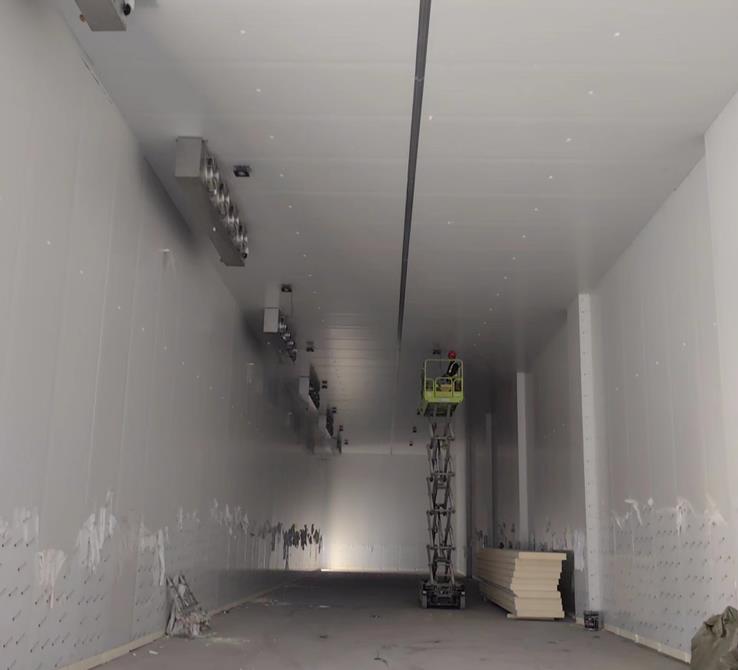
100 mm-thick double-sided color steel polyurethane sandwich panels are adopted, with a density of 42 kg/m³ and thermal conductivity ≤0.022 W/(m·K). Panels are connected via tongue-and-groove joints filled with sealant. Pre-fabricated modular panels weigh only 14 kg/m² and require no wet construction during installation, fully complying with floor load limits.
The enclosure dimensions are 7.2 m × 5.4 m × 2.4 m (L×W×H) with an effective volume of approximately 93 m³. One 800×1900 mm semi-recessed sliding door is equipped, with built-in 36 V electric heating wires in the door frame for anti-condensation purposes.
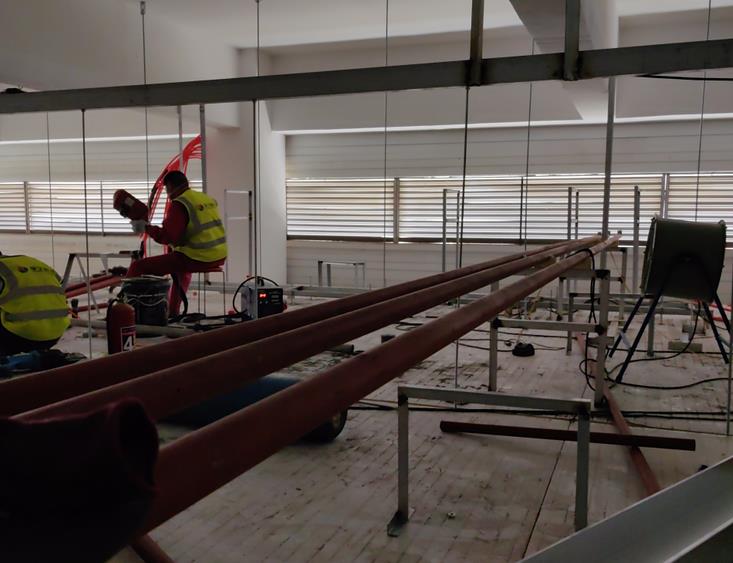
2. Core Configuration of Refrigeration System
Compressor Unit
Fully hermetic scroll compressors manufactured by Brazil-based Embraco, Model VEGY6H, rated power 3.5 HP, charged with R449A refrigerant. The continuous compression process of scroll compressors inherently suppresses suction pulsation. Driven by frequency converters, the capacity can be steplessly regulated within 20%–100% to match part-load operating conditions.
Condensing Side
Remote air-cooled condensers fitted with EC variable-speed fans that automatically adjust rotation speed based on condensing pressure, enabling stable operation under ambient temperatures ranging from -15℃ to +45℃.
Evaporating Side
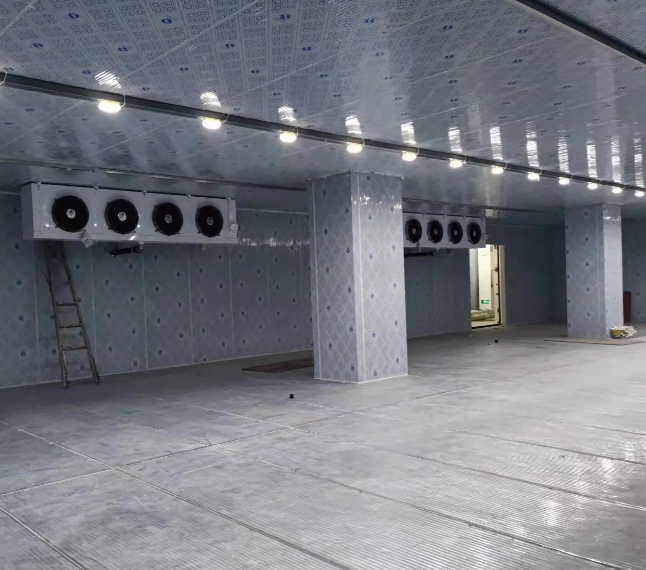
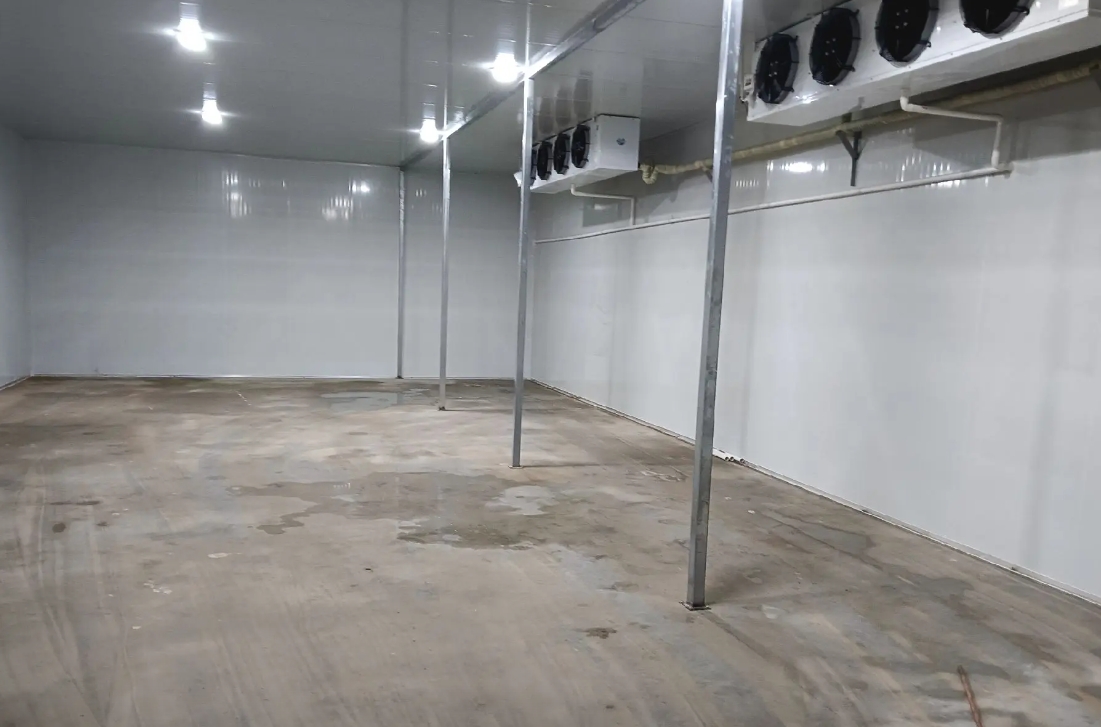
Custom low-profile ceiling-mounted air coolers with an overall height of merely 350 mm and dual air outlets, equipped with external rotor axial fans and an air volume of 2,500 m³/h. The 4.5 mm fin spacing provides dustproof performance, with an electric defrost power of 2.1 kW. Defrost logic is optimized by the controller to minimize temperature rise inside the warehouse.
3. Precision Control System
The master controller adopts Carel PJ series digital thermostats paired with NTC temperature sensors offering ±0.2℃ accuracy, installed in the return air zone at the geometric center of the warehouse.
Control Strategies
PID plus feedforward algorithm is applied to pre-compensate cooling capacity according to door opening frequency;
Dual defrost modes of demand-based defrost plus time backup are adopted. Defrost terminates when coil temperature reaches ≥8℃ or after a maximum duration of 10 minutes, limiting warehouse temperature rise to ≤2℃ during defrost cycles;
Remote alarming: dry contacts connect to the client’s BMS system to push alerts for over/under temperature, power failure and sensor faults to the facility management team.
4. Air Distribution Layout Matched with Racking Systems
To eliminate airflow dead zones caused by stacked raw material barrels, an air circulation scheme of top supply and bottom return is designed. The ceiling-mounted air cooler is installed at the central position, with arc deflectors mounted at air outlets to attach cold airflow to the ceiling and deliver it to the far end. Cold air sinks naturally and returns through the bottom of racks. CFD simulation verifies that the maximum temperature difference across 9 measuring points inside the warehouse is 0.9℃, meeting process requirements.
5. Electrical & Safety Configuration
Separate WDZ-YJY-5×4 mm² cables are laid, matched with input filters for compressor inverters to suppress harmonic distortion. Emergency call buttons and IP65 LED explosion-proof lamps are installed inside the warehouse, while a Carel display screen outside the door shows real-time warehouse temperature, setpoint and unit operating status.
List of Core Equipment & Technical Parameters
| System / Equipment | Brand & Model | Key Parameters |
|---|---|---|
| Compressor | Embraco VEGY6H | Scroll type, 3.5 HP, R449A refrigerant |
| Digital Thermostat | Carel PJ32S | Control accuracy ±0.2℃, PID regulation |
| Air Cooler | Custom Ceiling-mounted Type | Heat exchange capacity 4.2 kW @ evaporating temperature -5℃ |
| Condenser | Domestic Model with EC Fans | Heat rejection capacity 5.8 kW, noise ≤52 dB(A) |
| Insulated Panels | Class B1 Polyurethane | Thickness 100 mm, λ=0.022 W/(m·K) |
| Warehouse Door | Semi-recessed Sliding Door | Electric anti-condensation heating, manual internal release |
| Refrigerant | R449A | GWP=1397, ODP=0 |
Commissioning & Qualification Test Process
Cooling-down Test: The empty warehouse cools down from ambient 28℃ to setpoint 7℃ within 38 minutes.
Steady-state Performance: Continuous 48-hour operation at set temperature 5℃. Temperature records fluctuate between 4.8℃ and 5.6℃ with a standard deviation of 0.18℃; no alarms triggered except during defrost cycles.
Defrost Interference Test: Manual defrost initiated at warehouse temperature 5℃ and 50%RH. The peak warehouse temperature reaches 5.9℃ upon defrost completion and recovers to 5.3℃ within 10 minutes.
Power Failure Recovery Test: After 30-minute power cut, compressors start with delay without abnormal alarms. Warehouse temperature recovers from 6.8℃ to 5.5℃ in 22 minutes.
All test data are archived and delivered to the client as part of as-built documentation.
Significantly Improved Raw Material Stability: After commissioning, the Mooney viscosity fluctuation of raw silicone rubber between batches is reduced from ±8 MU to ±3 MU, and the shelf life of cross-linker activity is extended by approximately 40%.
Zero Process Interruptions: Six months of continuous operation with no raw material scrapping or production shutdowns attributable to cold storage malfunctions.
Energy Consumption Performance: Average daily power consumption stands at around 18.5 kWh, equivalent to 0.20 kWh per cubic meter per day, delivering roughly 32% energy savings compared with the client’s original cold storage.
Easy Maintenance: Modular insulated panels allow individual replacement; all refrigeration units feature full front-side access for servicing, and routine inspections can be completed by a single operator.
No matter your industry, no matter how complex your refrigeration needs, XNAIR Cold Storage can provide you with customized, energy-efficient solutions. Contact us now to start your successful project!
Contact XNAIR Cold Storage Now →Hedong Canteen Cold Storage Project at East China Normal University: Customized catering cold storage solution with German Bitzer system, -18℃ and 2-8℃ dual-temperature zones, energy-efficient design...
View Details →Shanghai XNAIR builds climate-resilient seed cold storage for Wuwangnong Seed in Lishui, maintaining 0-10℃ stability at 43℃ ambient with 48hr backup power, ensuring genetic resource security....
View Details →XiangNing Cold Storage provided EPC solutions for Hetian Eheng's agricultural cold chain logistics center in Pishan County, including thermal insulation materials, installation, and intelligent contro...
View Details →Shanghai XNAIR delivers 5-10℃ adjustable cold storage for Xihekang's semiconductor silicone raw materials in Xuhui, using Embraco compressors and modular design to ensure material stability for el...
View Details →Shanghai Haohai Biotech's 2024 pharmaceutical cold storage project, featuring German Bitzer refrigeration & Schneider control systems, meets GMP/ISO standards for high-precision medical storage....
View Details →Shanghai XNAIR delivers fire-resistant 0-5℃ tobacco leaf cold storage for Jiangxi Tobacco Research, using German GEA refrigeration and B1-grade insulation to meet agricultural research & food safe...
View Details →Phone
+86 180 1742 6215Tel
Shanghai XiangNing Electromechanical Equipment Co., LTD XML