Shanghai XNAIR retrofits Saint-Gobain's Shanghai plant with 9℃ precision cold storage for automotive glass raw materials, integrating existing glass wall structures with energy-efficient refrigera
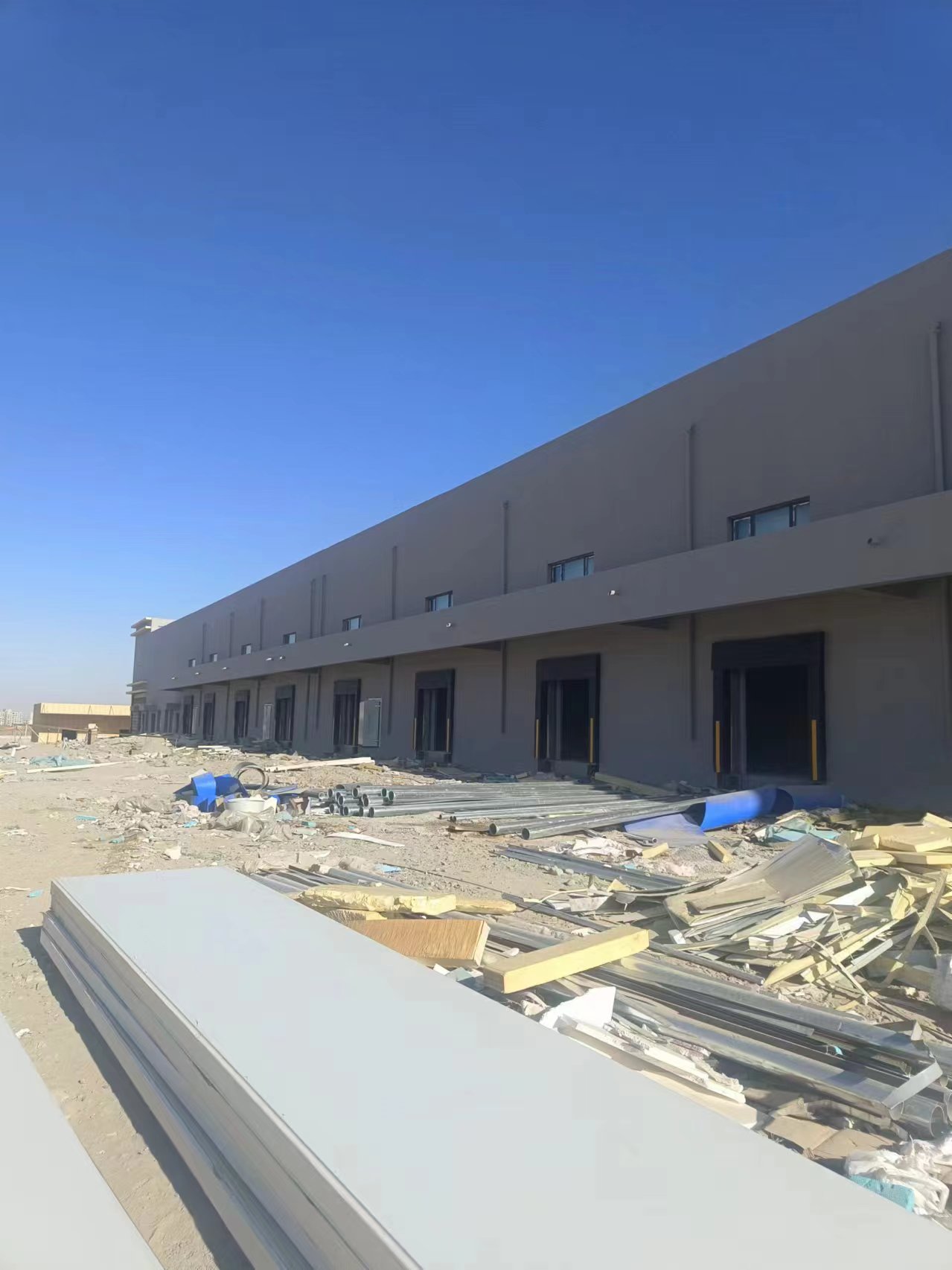
The project is located inside Saint-Gobain’s Shanghai plant and involves the renovation of the storage area for key raw materials used in automotive glass manufacturing. The original site was a clean material room enclosed by glass walls with a floor area of 500 square meters. Fluctuations in temperature and humidity exceeded process requirements, making it unsuitable for stable storage of temperature-sensitive materials such as PVB films and screen printing inks. XNAIR undertook the refrigeration renovation of this space, upgrading it into a precision constant-temperature cold storage maintained at 9℃±1℃. The thermal insulation system, refrigeration system and control system were installed without dismantling the original glass structure, with a construction period of 30 days. The project has clear objectives: to build an industrial raw material cold storage operating stably all year round at 9℃±1℃ utilizing the existing glass partitions, reduce material scrappage caused by temperature fluctuations, and provide traceable temperature control data for subsequent material management in clean areas.
Project Background
Saint-Gobain Shanghai Plant mainly manufactures automotive windshields, side windows and sunroof glass, with production processes including PVB laminating, screen printing and adhesive coating. PVB film readily absorbs moisture and sticks together under high temperature or high humidity, resulting in optical distortion and reduced bonding strength after lamination. Screen printing ink is also temperature-sensitive; elevated temperatures accelerate solvent volatilization, alter printing viscosity and directly lower finished product yield.
The plant originally used cabinet air conditioners for cooling in this area. Actual indoor temperature fluctuated between 12°C and 18°C in summer. In addition, the glass-enclosed space was heavily affected by sunlight and workshop heat radiation, creating frequent local hot spots. Annual losses caused by raw material quality degradation reached hundreds of thousands of RMB.
Since the room adjoins the clean production workshop and the glass walls serve for plant tours and natural lighting, the factory refused full demolition and reconstruction. It therefore decided to carry out on-site precision cold storage renovation to stabilize storage temperature at 9℃±1℃.
Key Challenges
Challenge 1: Thermal insulation renovation and cold bridge suppression for glass enclosures
The original walls are floor-to-ceiling tempered glass partitions. Glass features extremely low thermal resistance, and aluminum alloy framing forms extensive linear cold bridges. The conventional method of attaching insulation panels directly to the inner glass surface is unfeasible here: the smooth glass cannot bear expansion anchors, while adhesive bonding carries a risk of detachment under long-term load.
Furthermore, the exterior environment is hot and humid in summer. Without a complete vapor barrier on the inner glass surface, condensed water will easily accumulate between the insulation and glass, triggering mold growth and endangering the cleanroom environment.
Challenge 2: Construction amid non-stop production
The material storage room is adjacent to the running clean automotive glass production line, which must remain operational throughout construction. On-site assembly of polyurethane panels, copper pipe welding and electrical cable tray installation generate dust, noise and vibration that require strict containment. Any particulate emissions exceeding cleanroom standards may cause speckle defects on glass products on the production line. The 30-day construction schedule demands highly cross-disciplinary parallel work with almost no margin for error.
Challenge 3: High refrigeration modulation capacity required for precise temperature control
A temperature accuracy of 9℃±1°C is a stringent standard for industrial raw material storage. Conventional fixed-frequency piston or scroll compressors rely on on-off cycling, leading to severe temperature overshoot and hysteresis that cannot sustain ±1°C stability. The warehouse door opening frequency varies irregularly each day, and incoming materials sometimes arrive at temperatures close to ambient workshop conditions, creating sharp fluctuations in cooling load.
The refrigeration system must deliver rapid cooling capacity adjustment. Failing this, repeated excessive cooling of the evaporator will trigger over-dehumidification and sudden drops in supply air temperature, which adversely impacts the flexibility of PVB film.
Design Scheme
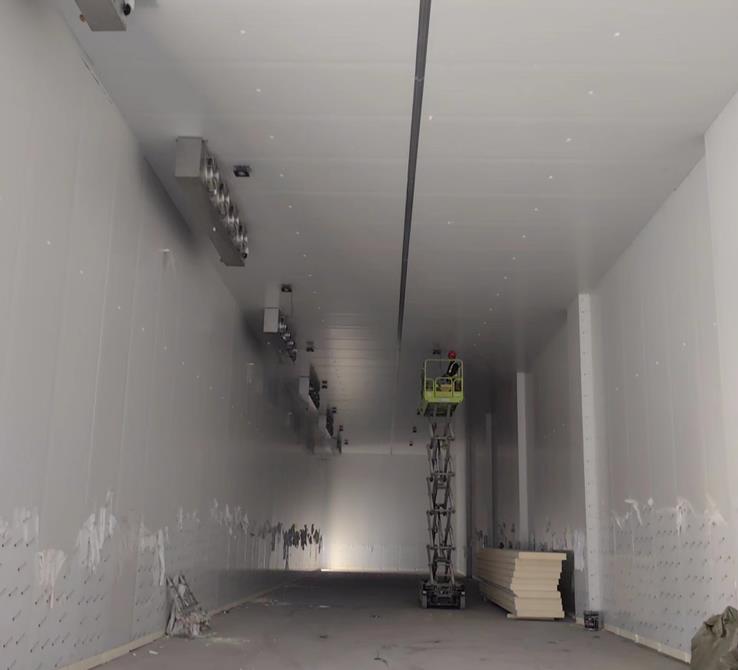
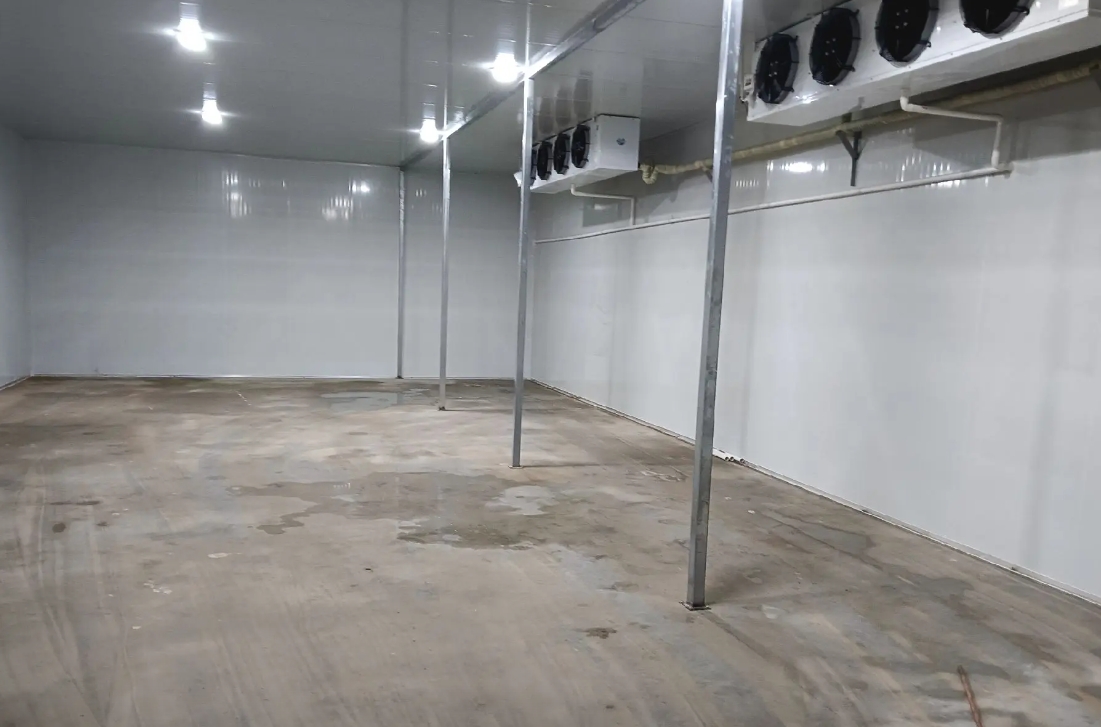
The original glass enclosure is treated as the outer shell, and an independent insulated warehouse structure is built inside to form a "warehouse within warehouse" layout. A 50 mm air gap is reserved between the outer surface of the insulated panels and the glass wall. This air layer blocks direct structural heat transfer and prevents condensation on the glass surface caused by direct contact with internal thermal insulation.
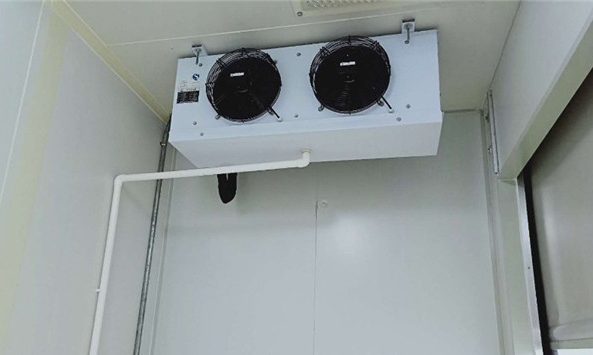
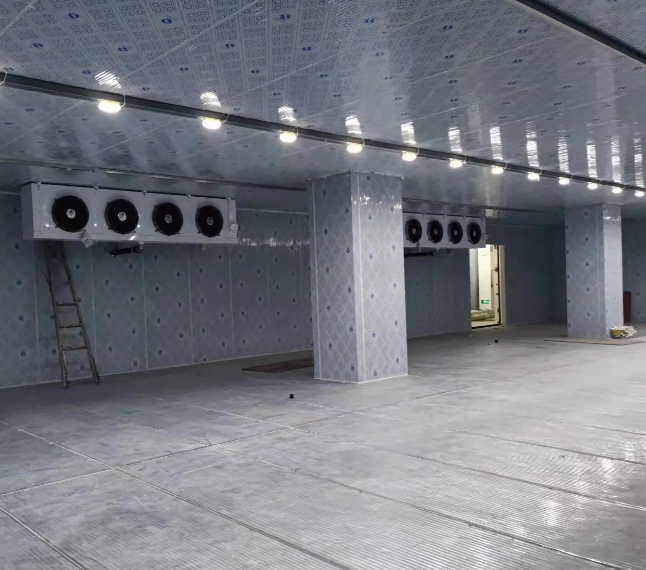
Ceiling-mounted air coolers are arranged symmetrically on the warehouse roof with a top-air-supply and bottom-air-return airflow pattern to guarantee uniform temperature distribution across all zones. A single continuously operating variable-frequency unit is adopted for the refrigeration system without a standby main unit. However, power supply for key sensors and controllers is backed by UPS to sustain monitoring and retain safe shutdown records during power outages.
A cascade PID control logic combining supply air temperature and return air temperature is deployed for temperature regulation. The outer loop calculates the target supply air temperature based on the deviation between the set warehouse temperature and the average return air temperature measured at multiple points. The inner loop adjusts the compressor speed and electronic expansion valve opening to maintain a narrow temperature band around 9°C for supply air, preventing localized overcooling of materials from direct cold air blow.
When heat load is extremely low, a hot gas bypass valve diverts part of the discharge gas back to the suction side to keep the compressor running continuously and eliminate temperature fluctuations induced by startup shocks.
Equipment List
| Equipment Name | Brand & Model | Function |
|---|---|---|
| Variable-Frequency Air-Cooled Condensing Unit | Emerson Copeland ZRD84KCE-TFD variable scroll compressor with variable frequency drive | Provides stepless adjustable cooling capacity to accommodate fluctuating loads |
| Ceiling-Mounted Air Cooler | Kaysun KBT-550D dual-air-outlet type with external balanced thermostatic expansion valve | Distributes low-temperature air evenly inside the warehouse to remove heat load |
| Electronic Expansion Valve | Emerson EX6-i21 stepping motor driven | Precisely regulates refrigerant flow to match variable compressor output |
| Control System | Siemens S7-1200 PLC + TP700 touch screen + Class A precision Pt100 temperature sensors | Executes operational logic, collects real-time temperature & humidity data, records historical data and sends alarm notifications |
| Polyurethane Insulated Panel | 100 mm thickness, double-sided 0.5 mm color steel sheet, PIR foam core, Class B1 fire resistance | Forms independent thermal enclosure inside the glass wall |
| Hot Gas Bypass Assembly | Solenoid valve + manual shut-off valve + bypass pipeline | Prevents frequent compressor cycling under low-load conditions |
Construction Process
Insulated panels are fixed to the floor inside the glass wall via anchored floor grooves; the top of the structure does not touch the original ceiling joists to ensure full independence. Polyurethane foam filler is injected into panel joints, which are then covered with self-adhesive aluminum foil sealing tape on the exterior to block water vapor penetration.
Air cooler hangers are secured to the original building beams and columns without applying any load to the glass walls. The refrigeration unit is installed on an equipment platform outside the material room. Flexible sealing sleeves are used at copper pipe wall penetrations to isolate vibration and cold conduction to the glass curtain wall.
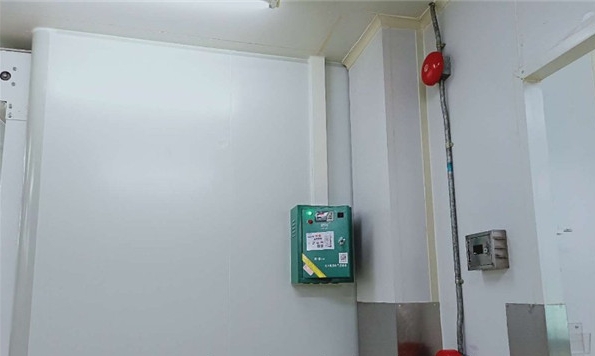
Electrical cable trays are routed along the outer wall of the insulated warehouse, with clean sealing fittings installed at all cable entry and exit points. The control cabinet is mounted outside the warehouse for easy access.
During construction, a temporary negative-pressure enclosed working zone is set up with real-time particle counter monitoring. Cleanliness restoration procedures are implemented after each work shift clearance.
Commissioning & Acceptance
For no-load commissioning, air tightness and pressure holding tests are carried out first. After confirming zero leakage of the refrigeration system, the unit is started to cool the warehouse from the workshop ambient temperature of 32°C down to 9°C, to test cooling rate and initial temperature overshoot.
Nine temperature measuring points arranged in a 3-layer × 3-column grid are used to verify no-load temperature distribution. After 8 hours of stable operation, the maximum temperature deviation is controlled within ±0.7°C.
Simulated loads (pallets filled with thermal mass media) are then placed inside, and daily door-opening operations are simulated for 48 consecutive hours of running. The final full-load temperature records show all measuring points fall within 8.3~9.6°C, complying with the 9℃±1°C specification.
Acceptance is jointly verified by Saint-Gobain’s process, equipment and quality departments. Continuous temperature monitoring as well as SMS and email alarm functions are formally handed over upon completion.
Validation Results
According to 48-hour full-load temperature distribution data, the maximum temperature was 9.6°C, the minimum 8.3°C, with an average of 9.0°C and a temperature fluctuation range of ±0.65°C. Compared with the pre-renovation air-conditioned room where temperatures fluctuated between 14°C and 18°C with local hot spots exceeding 20°C, the temperature control performance improved by an order of magnitude, fully meeting the storage requirements for PVB films.
Actual Operational Performance
The facility has successfully endured a full plum rain season and sweltering summer after commissioning. Operation curves logged by the Siemens PLC show that the indoor temperature remained stable within the target range even when the outdoor ambient temperature varied from 25°C to 38°C.
The variable-frequency compressor operated mostly under 40%–70% load with zero on-off cycling. The defrost cycle of air coolers was adjusted based on light frost accumulation, requiring virtually no electric heating assistance. No false alarms were triggered by the monitoring system.
Project Benefits
In terms of storage losses, scrapping of PVB films caused by adhesion resulting from improper temperature and humidity was reduced by around 85%. Viscosity inconsistency between ink batches was minimized, shortening printing setup time.
For daily operation management, warehouse staff can directly retrieve temperature history curves via the touch screen, eliminating errors and omissions from manual meter reading and enabling complete traceability.
The original glass wall structure was fully retained, preserving natural lighting and visual transparency for tours in the clean corridor. Extra civil reconstruction costs were avoided, keeping the total budget below one-third of the cost for a full civil renovation alternative.
No matter your industry, no matter how complex your refrigeration needs, XNAIR Cold Storage can provide you with customized, energy-efficient solutions. Contact us now to start your successful project!
Contact XNAIR Cold Storage Now →Hedong Canteen Cold Storage Project at East China Normal University: Customized catering cold storage solution with German Bitzer system, -18℃ and 2-8℃ dual-temperature zones, energy-efficient design...
View Details →Shanghai XNAIR builds climate-resilient seed cold storage for Wuwangnong Seed in Lishui, maintaining 0-10℃ stability at 43℃ ambient with 48hr backup power, ensuring genetic resource security....
View Details →XiangNing Cold Storage provided EPC solutions for Hetian Eheng's agricultural cold chain logistics center in Pishan County, including thermal insulation materials, installation, and intelligent contro...
View Details →Shanghai XNAIR delivers 5-10℃ adjustable cold storage for Xihekang's semiconductor silicone raw materials in Xuhui, using Embraco compressors and modular design to ensure material stability for el...
View Details →Shanghai Haohai Biotech's 2024 pharmaceutical cold storage project, featuring German Bitzer refrigeration & Schneider control systems, meets GMP/ISO standards for high-precision medical storage....
View Details →Shanghai XNAIR delivers fire-resistant 0-5℃ tobacco leaf cold storage for Jiangxi Tobacco Research, using German GEA refrigeration and B1-grade insulation to meet agricultural research & food safe...
View Details →Phone
+86 180 1742 6215Tel
Shanghai XiangNing Electromechanical Equipment Co., LTD XML