Shanghai Modern Pharma's 730m³ GSP-compliant cold storage solution ensureswith dual compressors, real-time, and 24/7 power backup. Trusted by.
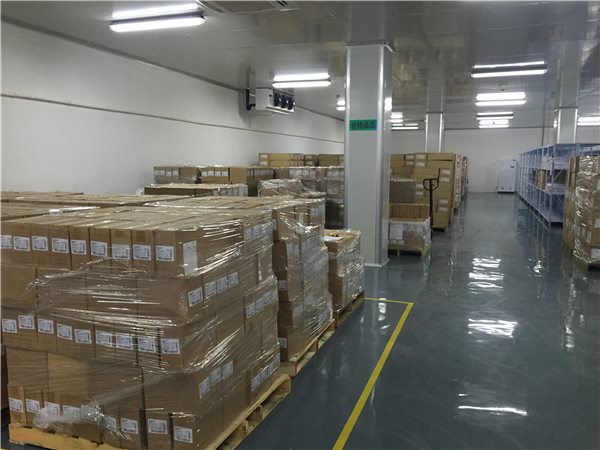
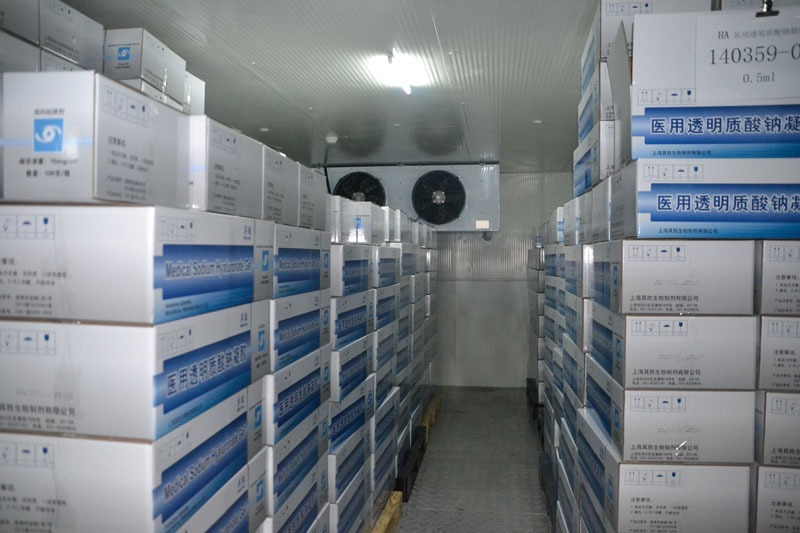
As a listed pharmaceutical enterprise under China National Pharmaceutical Group (Sinopharm), Shanghai Modern Pharmaceutical specializes in the production of chemical preparations and active pharmaceutical ingredients (APIs). To meet the compliant pharmaceutical warehousing demands brought by capacity expansion, the company constructed a new 730 m³ pharmaceutical refrigerated warehouse within its Shanghai plant. The warehouse is designed with a temperature control range of 2°C to 8°C and built in strict accordance with the Good Supply Practice for Pharmaceutical Products (GSP). It is equipped with a dual-compressor alternating refrigeration system, a real-time temperature and humidity monitoring system supporting SMS alarms, and an all-weather backup power supply system. The core objectives are to maintain a stable and controllable storage environment for finished pharmaceutical preparations and APIs, and satisfy drug regulatory compliance as well as production supply chain requirements.
Project Background
Shanghai Modern Pharmaceutical is mainly engaged in the R&D, production and sales of anti-infective, cardiovascular and anti-tumor chemical preparations as well as their corresponding active pharmaceutical ingredients (APIs). Its products are highly temperature-sensitive during storage; most injectable raw materials and biological preparations require long-term storage at 2°C–8°C.
Previously, the company relied on three scattered small cold rooms within the plant for storage. The total storage capacity was insufficient, and the equipment had been in service for more than 8 years with severe temperature control fluctuations. The original monitoring system only supported local data recording, lacking remote alarm and data traceability functions, which failed to meet the mandatory requirements of the latest version of GSP for pharmaceutical cold chain warehousing. Meanwhile, with capacity expansion of oral solid dosage and injection production lines, the refrigerated throughput of finished products and raw materials rose by 40% year-on-year, creating shortages in both storage capacity and compliance capacity.
Against this backdrop, the enterprise launched a new standardized pharmaceutical cold storage project, positioned as the core cold chain storage hub of the plant with two major functions: finished product temporary storage and raw material turnover. Mandatory requirements include one-time pass of GSP temperature mapping validation, 7×24-hour uninterrupted temperature control, and equipment redundancy backup capability to eliminate pharmaceutical quality risks caused by single-point failures.
Key Challenges
1. Restricted construction space inside the plant, construction operations must avoid production flow lines
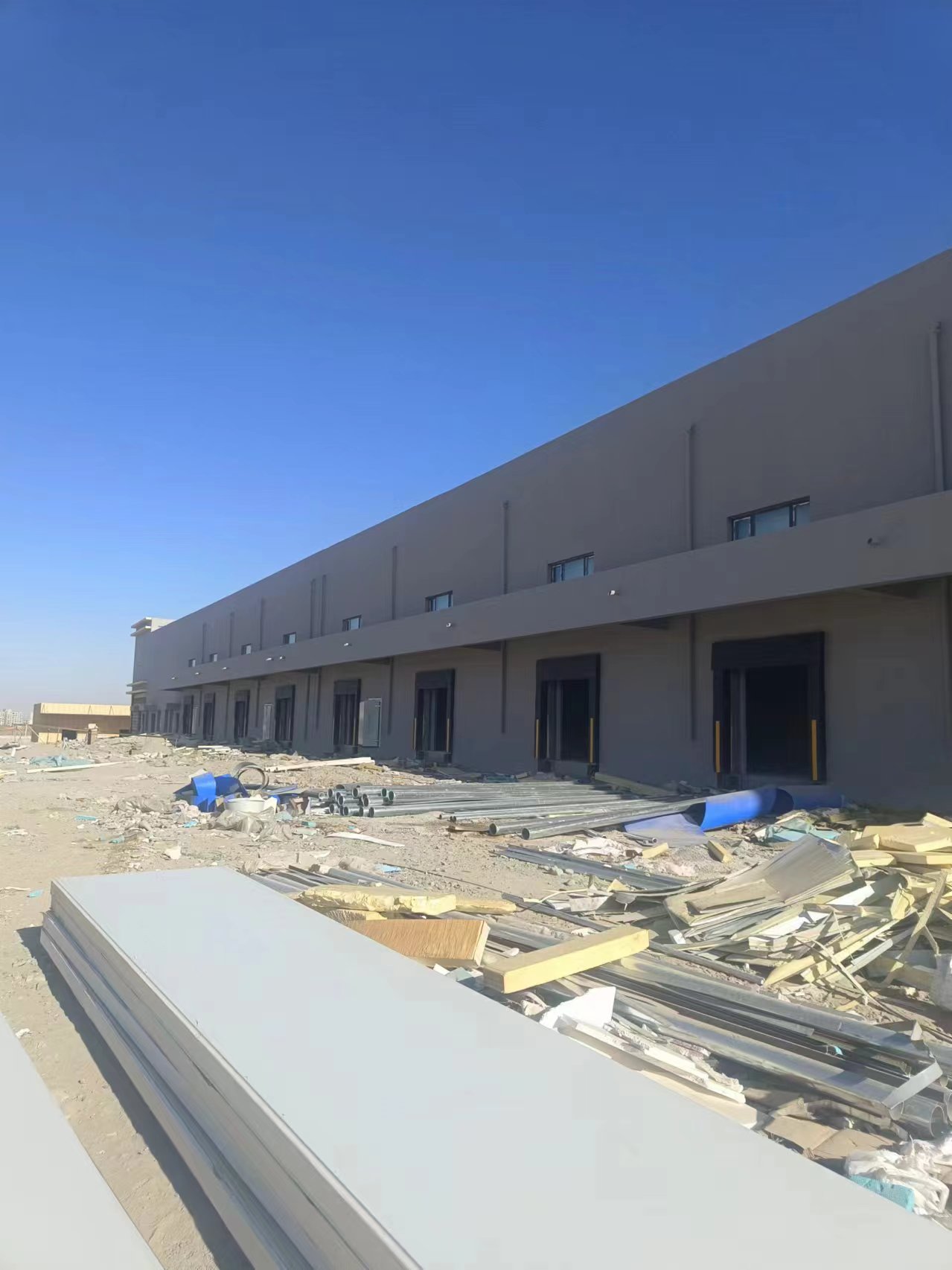
The cold storage is built on reserved storage land inside the existing production plant, adjacent to an oral preparation workshop and a general raw material warehouse. The horizontal width of the construction site is less than 12 meters; equipment hoisting and building material delivery can only be carried out via a dedicated passage on the west side of the plant, and all work must avoid morning, noon and evening peaks of production material transportation. In addition, construction activities must comply with the plant’s clean production management rules, prohibiting dust and odor from spreading to production areas, imposing strict constraints on construction procedures and working hours.
2. Multiple GSP compliance dimensions and stringent validation standards
The pharmaceutical cold storage must fully satisfy all provisions for refrigerated medicinal products specified in the GSP appendix. Beyond the core temperature range of 2°C–8°C, the system must refresh temperature and humidity data every minute, automatically record data every 30 minutes, and store tamper-proof records. Dual alarm mechanisms are required: local audible & visual alarms plus remote SMS alerts, with alarm notifications simultaneously sent to no fewer than three management staff.
Both the refrigeration and power supply systems must feature redundancy backup; failure of a single piece of equipment shall not interrupt temperature control. A third-party institution must issue a temperature distribution validation report, and acceptance is only approved when all measuring points across the warehouse meet standards.
3. High risk of cooling load fluctuations under hot and humid summers in Shanghai
Shanghai’s extreme summer maximum temperature can exceed 38°C, and relative humidity stays above 80% RH for long periods during the plum rain season, leading to cooling load fluctuations of up to 30% on the cold storage enclosure structure. High temperature and humidity amplify condensation when warehouse doors open and reduce the heat exchange efficiency of air coolers. Insufficient refrigeration system margin will cause excessive temperature rise and heavy frost accumulation inside the warehouse, raising higher standards for refrigeration load design and thermal insulation sealing performance.
4. Zero interruption requirement for pharmaceutical storage, qualified system fault tolerance
The APIs and finished preparations stored in this cold storage carry high value per batch, and some varieties are clinically essential medicines, making temperature control interruption unacceptable. Failure of any core component — refrigeration compressor, power supply or monitoring equipment — must not push warehouse temperature outside the 2°C–8°C range, and data recording must remain continuous during system switchover. All core links require backup schemes with fully automatic switchover without manual intervention.
Design Solution
Temperature & Airflow Design
The warehouse temperature control range is set at 2°C–8°C with a design precision of ±0.5°C. Equipped with humidity adjustment functions, it maintains relative humidity between 45%–75% RH to meet pharmaceutical storage humidity standards.
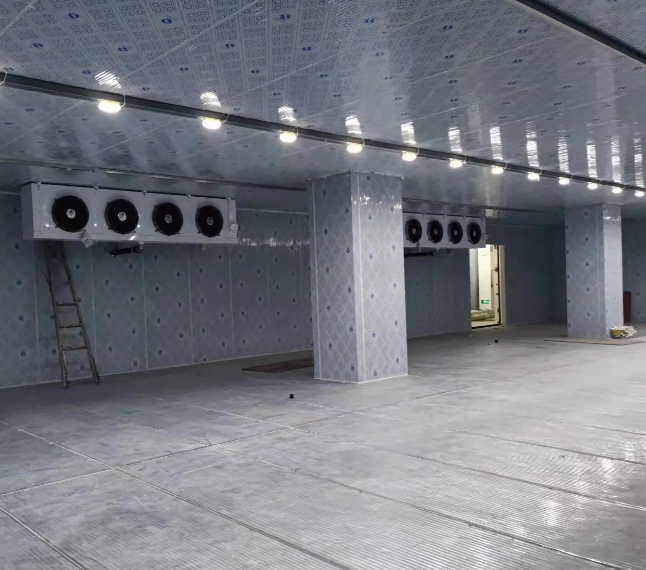
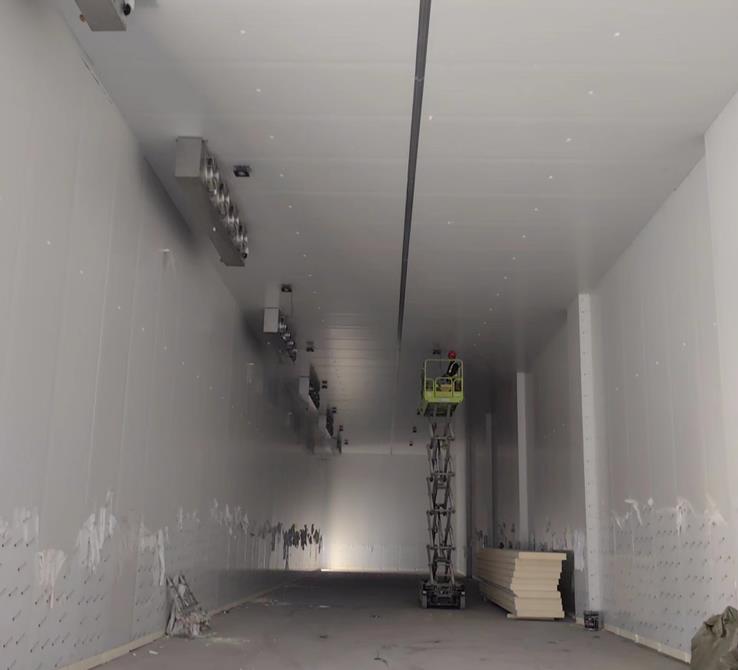
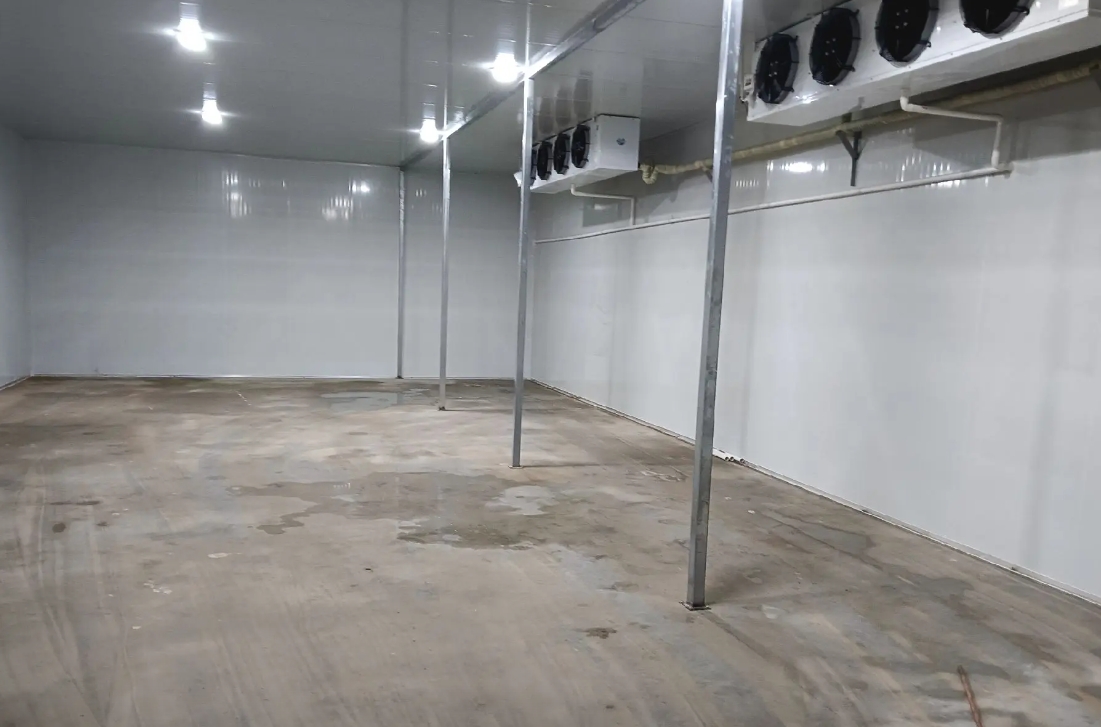
A dual-side ceiling air supply layout is adopted for air distribution. Four air coolers are symmetrically arranged along the warehouse length, with air outlets facing aisles to prevent cold air from blowing directly onto stacked pharmaceutical goods. Return air outlets are installed at the lower part of the enclosure to form an upper-supply and lower-return circulating airflow, eliminating temperature dead zones in warehouse corners and the bottom of racks and guaranteeing uniform temperature across the entire space.
Refrigeration System Design
A parallel alternating operation structure with twin piston compressors is deployed. The two compressors feature identical models and cooling capacities; they automatically alternate startup and shutdown during normal operation to balance equipment wear and extend service life.
When one compressor malfunctions, the control system automatically detects the fault and starts the standby unit to run at full load, providing 100% redundant cooling capacity and preventing excessive temperature deviations inside the warehouse.
The two refrigeration systems are each equipped with independent air-cooled condensers, thermostatic expansion valves and refrigerant circuits with isolated pipelines, ensuring a single-point fault cannot crash the whole system.
Backup System Design
A three-tier power protection architecture is implemented: dual municipal power circuits + diesel generator set + UPS uninterruptible power supply.
Dual municipal power supplies are sourced from different plant substations, with an automatic switch realizing millisecond-level power transfer.
A matching 30 kW diesel generator automatically starts within 15 seconds upon complete mains failure to sustain continuous refrigeration.
A 2 kVA online UPS independently powers the control and temperature-humidity monitoring systems to avoid data loss at power cut moments and guarantee normal alarm triggering.
| Equipment Name | Brand & Model | Function |
|---|---|---|
| Refrigeration Compressor | 2 × Bitzer 4TES-9 Piston Compressors | Supplies cooling source; alternating operation with fault redundancy backup |
| Air-Cooled Condenser | 2 × FNZ-60 High-efficiency Air-cooled Condensers | Dissipates heat for matched compressors; adapts to hot summer conditions in Shanghai to secure condensing efficiency |
| Ceiling-Mounted Air Cooler | 4 × DL-80 Ceiling Air Coolers | Enables indoor air heat exchange and even cold air delivery, equipped with defrost function |
| Insulated Warehouse Panel | 100 mm thick Class B2 flame-retardant polyurethane color steel panel | Thermal insulation for warehouse enclosure; thermal conductivity ≤0.022 W/(m·K), complying with plant fire resistance requirements |
| Refrigeration Control Cabinet | PLC Full-automatic Dual-unit Control Cabinet | Automatic temperature regulation, alternating compressor startup/shutdown, automatic fault switchover and parameter logging |
| Temperature & Humidity Monitoring System | GSP Pharmaceutical Grade Temperature & Humidity Recorder (6 measuring points) | Real-time collection and automatic storage of temperature & humidity data; triggers local audible-visual alarms and SMS alerts once thresholds are exceeded |
| Diesel Generator Set | 30 kW Full-automatic Diesel Generator | Supplies power to refrigeration systems during mains outages to maintain stable temperature control |
| UPS Uninterruptible Power Supply | 2 kVA Online UPS | Provides uninterrupted power for control and monitoring systems to protect data recording and alarm functions |
Construction Process
Installation of Insulated Cold Storage Panels
Construction shall strictly follow the working sequence: ceiling first, then wall panels, and finally the floor.
100 mm-thick Class B2 flame-retardant double-sided color coated polyurethane panels are adopted with a core density of 38 kg/m³. The gap between spliced panels shall be controlled within 1.5 mm. Neutral silicone sealant is evenly coated on joint surfaces, which are fastened by special eccentric hook connectors at a horizontal spacing of 600 mm.
A spirit level is used for calibration throughout wall installation, with verticality deviation controlled within ≤2 mm/m. Galvanized steel reinforcing frames are installed around door openings to disperse stress from frequent door opening and closing and prevent permanent deformation over long-term use.
For floor construction: a polyethylene polypropylene vapor barrier is laid first with an overlapping width of 10 cm, followed by staggered floor insulation boards. A 100 mm-thick C20 concrete slab is poured on top, with an evenly distributed load capacity of ≥15 kN/㎡ to meet forklift operation demands. All wall-penetrating pipes and wiring holes are filled with polyurethane foam and sealed with sealant to completely eliminate cold bridges.
Installation of Refrigeration Equipment and Piping
Compressors are installed on dedicated outdoor equipment platforms with rubber vibration-damping bases underneath; the horizontal deviation of each unit is limited to ≤0.1 mm/m. Condensers are mounted with a minimum clearance of 1.5 m between ventilation surfaces and walls to avoid hot air recirculation and reduced heat dissipation efficiency.
Indoor air coolers are suspended by galvanized hangers, with thermal insulation gaskets fitted at joints between hangers and ceiling panels to block cold bridges. Air outlets are tilted downward by 15° to avoid direct cold airflow blowing onto pharmaceutical stacks.
TP2 copper tubes are used for refrigeration pipelines connected by brazing. The spacing of pipe supports and hangers complies with relevant standards, and sleeves are installed for protection where pipes penetrate walls.
After piping installation, nitrogen purging and air tightness tests are conducted: the system is charged with nitrogen at 1.6 MPa and held for 24 hours; a pressure drop of ≤0.02 MPa is deemed qualified. The system is then vacuumed down to -0.098 MPa, and refrigerant charging can only proceed if the vacuum degree remains stable without rebound within 24 hours.
All pipelines are wrapped externally with 20 mm-thick rubber-plastic thermal insulation cotton and wound with aluminum foil to prevent condensation.
Installation of Electrical and Monitoring Systems
Power cables and control cables are laid separately and protected by galvanized conduits. All indoor wiring is treated with moisture-proof sealing. Explosion-proof and moisture-resistant LED lamps equipped with emergency lighting modules are installed inside the warehouse, which can provide continuous illumination for more than 30 minutes after power failure.
Dual municipal power supplies are connected to an automatic transfer cabinet interlocked with the diesel generator set, programmed to automatically start the generator upon mains power loss and shut it down when mains power is restored.
Temperature and humidity sensors are arranged in compliance with GSP requirements: one sensor at each of the four warehouse corners, one at rack mid-height in the center, and one near the doorway. The sensor height aligns with the middle layer of pharmaceutical stacks to ensure collected data accurately reflects the actual storage environment.
The monitoring system is powered by an independent UPS. Data is stored locally and simultaneously uploaded to the plant management terminal, with a data retention period of over 5 years to satisfy traceability requirements.
Commissioning and Acceptance
No-load and Load Temperature Testing
No-load commissioning is carried out first: warehouse doors are closed, and the refrigeration system runs continuously for 72 hours. The temperature and humidity system records readings from all measuring points every 30 minutes to verify temperature stability and uniformity.
Test results show temperatures at all measuring points remain steadily within 2°C–8°C, with a maximum fluctuation of ≤±0.4°C, an overall indoor temperature difference of ≤0.8°C, and no obvious temperature dead zones.
An 80% load test is implemented subsequently: simulated cargo boxes are stacked to 80% of the designed storage capacity to replicate real storage conditions, with continuous operation for 48 hours to verify refrigeration performance and defrost logic under partial load. It is confirmed that temperature rise during defrost cycles does not exceed 1°C, complying with regulatory standards.
System Function Testing
Redundancy backup functions are tested item by item:
When power supply to one compressor is manually cut off, the control system identifies the fault within 25 seconds and activates the standby unit. Warehouse temperature fluctuation during switchover is ≤0.6°C, staying within the allowable range.
When mains power failure is simulated, the UPS instantly supplies power to the control and monitoring systems, and the diesel generator starts within 12 seconds to output stable voltage, with zero interruption to temperature control throughout the whole process.
Alarm function tests cover four scenarios respectively: over-temperature, under-temperature, power failure and equipment fault. Local audible and visual alarms trigger immediately in all cases, while SMS alerts are sent to the mobile phones of 3 pre-designated managers with a push delay of ≤10 seconds, meeting GSP alarm specifications.
Acceptance Procedure
The construction contractor completes self-inspection and submits a full set of construction documents, including air tightness test reports, electrical insulation test reports and equipment commissioning records.
The client’s warehousing and quality departments conduct preliminary acceptance to cross-check consistency between equipment models, operating parameters and design drawings.
A qualified third-party pharmaceutical cold chain verification institute is commissioned to complete temperature mapping validation in accordance with GSP specifications and issue an official validation report. Final acceptance is granted only after all cold storage indicators fully comply with the Good Supply Practice for Pharmaceutical Products (GSP).
Validation Results
The third-party GSP temperature validation report indicates that temperatures at all six measuring points inside the cold storage remained steadily within the 2°C–8°C range. Both temperature uniformity and fluctuation range exceed the thresholds specified in relevant codes. All functions of the temperature and humidity monitoring system — including sampling frequency, data storage, alarm mechanism and tamper-proof data storage — fully comply with the requirements of the GSP appendix. The system supports direct docking with the enterprise’s drug traceability system and drug regulatory supervision platform.
All redundancy system switchover tests passed acceptance criteria. Under three simulated scenarios — single compressor failure, single municipal power circuit outage, and complete mains power loss — no interruption of temperature control or data loss occurred. The warehouse temperature stayed within permissible limits throughout all tests, meeting reliability standards for uninterrupted pharmaceutical storage.
Actual Operational Performance
Over the six months since commissioning, the warehouse temperature has remained stable without any over-temperature violations. During Shanghai’s hot summer periods, the refrigeration system delivered sufficient cooling load. The air cooler defrost logic is well-calibrated, with no excessive frost accumulation or abnormal temperature swings inside the warehouse.
The monitoring system runs reliably with real-time upload of temperature and humidity data and automatic report generation and export. On one occasion, grid fluctuations at the plant triggered a backup power switchover. The system completed the entire switchover automatically without temperature deviations, while managers received simultaneous SMS alarms with no manual emergency intervention required.
The alternating operation mode of the dual compressors effectively balances equipment wear and tear; the operating hour difference between the two units is kept within 5%, slowing down aging of individual compressors. Routine maintenance only requires monthly general inspections and quarterly filter cleaning, keeping operational costs under control.
Project Benefits
Storage Capacity & Operational Efficiency
The 730 m³ effective storage volume satisfies the enterprise’s refrigerated turnover demand for finished products and raw materials for more than 30 days. It replaces three scattered small cold rooms and realizes centralized cold chain warehouse management. Optimized internal material flow improves inbound and outbound handling efficiency by approximately 25% and cuts waiting time for goods turnover.
Administrative Cost Savings
The fully automatic control system and intelligent monitoring platform enable unattended warehouse operation, eliminating the previous manual inspection cycle every two hours. Temperature and humidity logging and report generation are fully automated, reducing manual workload by roughly 40 working hours per month and lowering error risks associated with manual record-keeping.
Regulatory Compliance Value
The cold storage passed GSP validation in a single round and fully meets cold chain warehousing supervision requirements of drug authorities. It eliminates compliance risks brought by the outdated previous cold rooms, provides stable cold chain storage support for future production line expansion and new product launches, and guarantees consistent pharmaceutical quality and safety during storage.
No matter your industry, no matter how complex your refrigeration needs, XNAIR Cold Storage can provide you with customized, energy-efficient solutions. Contact us now to start your successful project!
Contact XNAIR Cold Storage Now →Hedong Canteen Cold Storage Project at East China Normal University: Customized catering cold storage solution with German Bitzer system, -18℃ and 2-8℃ dual-temperature zones, energy-efficient design...
View Details →Shanghai XNAIR builds climate-resilient seed cold storage for Wuwangnong Seed in Lishui, maintaining 0-10℃ stability at 43℃ ambient with 48hr backup power, ensuring genetic resource security....
View Details →XiangNing Cold Storage provided EPC solutions for Hetian Eheng's agricultural cold chain logistics center in Pishan County, including thermal insulation materials, installation, and intelligent contro...
View Details →Shanghai XNAIR delivers 5-10℃ adjustable cold storage for Xihekang's semiconductor silicone raw materials in Xuhui, using Embraco compressors and modular design to ensure material stability for el...
View Details →Shanghai Haohai Biotech's 2024 pharmaceutical cold storage project, featuring German Bitzer refrigeration & Schneider control systems, meets GMP/ISO standards for high-precision medical storage....
View Details →Shanghai XNAIR delivers fire-resistant 0-5℃ tobacco leaf cold storage for Jiangxi Tobacco Research, using German GEA refrigeration and B1-grade insulation to meet agricultural research & food safe...
View Details →Phone
+86 180 1742 6215Tel
Shanghai XiangNing Electromechanical Equipment Co., LTD XML