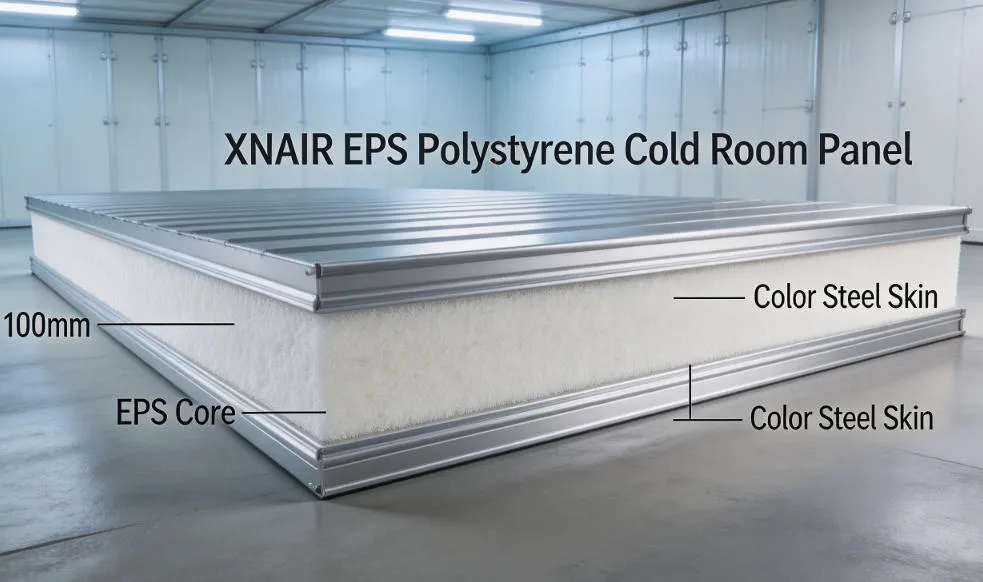
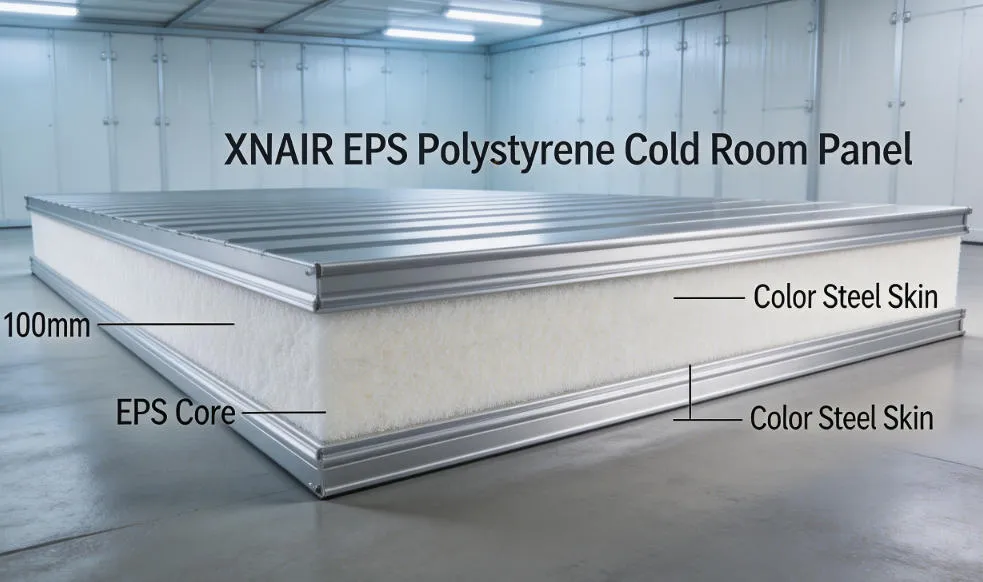
Product Summary: XNAIR EPS polystyrene cold room panels are prefabricated sandwich panels engineered for rapid on-site assembly of temperature-controlled enclosures. Each panel consists of a high-density EPS foam core (18–40 kg/m³) thermally bonded between two corrosion-resistant steel facings. The panel system achieves consistent thermal performance across its service life, with a design temperature range of -50°C to +50°C. All panels are manufactured to order with CNC-precision edge profiling, ensuring airtight interlocking joints that minimize thermal bridging and condensation risk.
Technical Specifications
The table below presents the core engineering parameters that professional cold storage contractors and procurement engineers evaluate when specifying EPS cold room panels. All values are based on factory-tested production standards and third-party laboratory verification.
| Parameter | Specification / Range | Unit | Remarks |
|---|---|---|---|
| Core Material | EPS (Expanded Polystyrene) | — | Density: 12–40 kg/m³ (standard: 18–22 kg/m³) |
| Panel Thickness | 50 / 75 / 100 / 120 / 150 / 200 | mm | Custom thickness available on request |
| Thermal Conductivity (λ) | 0.022 – 0.035 | W/m·K | Varies with EPS density; lower λ at higher density |
| R-Value (100mm panel) | 2.85 – 4.55 | m²·K/W | At 20°C mean temperature |
| Facing Material | Color steel / Galvanized steel / Stainless steel (304) | — | Thickness: 0.4–0.8mm; PE/SMP/PVDF coating available |
| Fire Rating | B1 (self-extinguishing) / B2 | — | Per GB 8624; equivalent to EN 13501-1 Class E / B-s2,d0 |
| Standard Panel Width | 960 / 1150 | mm | Cover width; module width includes joint profile |
| Panel Length | 2,000 – 12,000 | mm | Custom lengths within range; longer by special arrangement |
| Joint Type | Cam-lock / Eccentric hook / Tongue & groove | — | Cam-lock recommended for deep-freeze applications |
| Operating Temperature | -50 to +50 | °C | Sustained; not for cyclic extreme thermal shock |
| Weight (100mm panel) | Approx. 10–14 | kg/m² | Depending on facing thickness & EPS density |
| Compressive Strength | ≥ 60 – 180 | kPa | At 10% deformation; per GB/T 8813 |
| Water Absorption | ≤ 2 – 4 | % vol | Per GB/T 8810; after 24h immersion |
Note: Actual internal usable volume is marginally reduced by panel thickness. A cold room specified at 6m × 4m × 3m (external) with 100mm panels yields approximately 5.8m × 3.8m × 2.9m of internal clear space. This transparency ensures accurate capacity planning.
Application Scenarios
EPS polystyrene cold room panels from XNAIR serve as the primary thermal envelope in a wide spectrum of temperature-controlled environments. The following are the four highest-volume procurement sectors identified across our global export data.
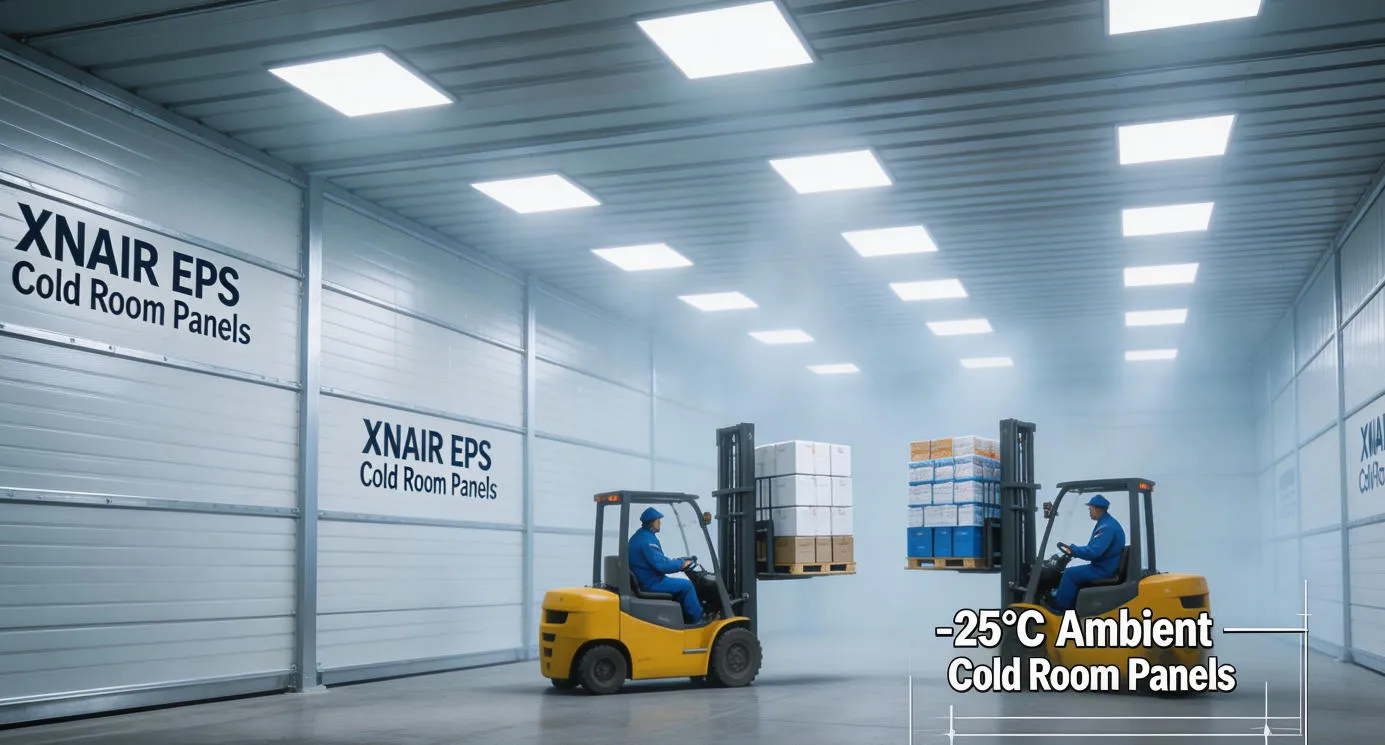
1. Food Processing & Cold Chain Logistics
From blast freezers to holding cold rooms, EPS panels provide the consistent thermal barrier required for HACCP-compliant food storage. Panels with stainless steel facings meet washdown hygiene requirements in meat, seafood, and dairy processing plants.
2. Pharmaceutical & Vaccine Cold Storage
Temperature-sensitive pharmaceutical products—including vaccines requiring 2–8°C storage—demand precise thermal stability. XNAIR EPS panels with cam-lock joints ensure minimal air leakage, supporting GMP-compliant cold chain infrastructure.
3. Industrial Freezer Warehouses
Deep-freeze logistics centers operating at -40°C to -50°C rely on 150–200mm thick EPS panels to minimize energy consumption while preventing frost heave at panel joints. Our high-density EPS cores resist long-term thermal drift under sustained low temperatures.
4. Agricultural & Horticultural Cold Storage
On-farm cold rooms for fresh produce, cut flowers, and seed storage benefit from rapid-build EPS panel systems. Panels can be assembled on a simple concrete slab foundation, enabling cost-effective cold storage deployment in rural and remote locations.
Global Adaptability & Regional Compliance
XNAIR EPS cold room panels are engineered to perform reliably across diverse climatic zones and regulatory environments. Below are the region-specific adaptations we implement for global export markets.
Africa & Middle East
Challenge: Ambient temperatures exceeding 45°C and intense solar radiation. Solution: Panels specified with higher EPS density (22–30 kg/m³) and reflective white PE-coated steel facings to reduce solar heat gain. Enhanced UV-stabilized edge sealants prevent thermal degradation of joint gaskets under prolonged sun exposure during outdoor staging.
Europe & North America
Challenge: Stringent energy codes and low-GWP refrigerant compatibility requirements. Solution: Panels available with EN 14509-compliant documentation and third-party CE marking. Facing materials compatible with low-GWP refrigerants (R-290, R-449A, CO₂). Fire performance data per EN 13501-1 available for building permit submissions.
Southeast Asia & South America
Challenge: High humidity (80–95% RH), monsoon-season condensation risk, and rough terrain transportation. Solution: Anti-corrosion galvanized steel facings with chromate-free passivation. Moisture-proof PE vapor barrier integrated into the panel core. Export packaging reinforced with steel edge protectors and heavy-duty pallet strapping for containerized sea freight over uneven road transport.
Engineering & Material Construction
Each XNAIR EPS cold room panel is a bonded composite structure designed for long-term dimensional stability under thermal load. The cross-sectional construction is detailed below.
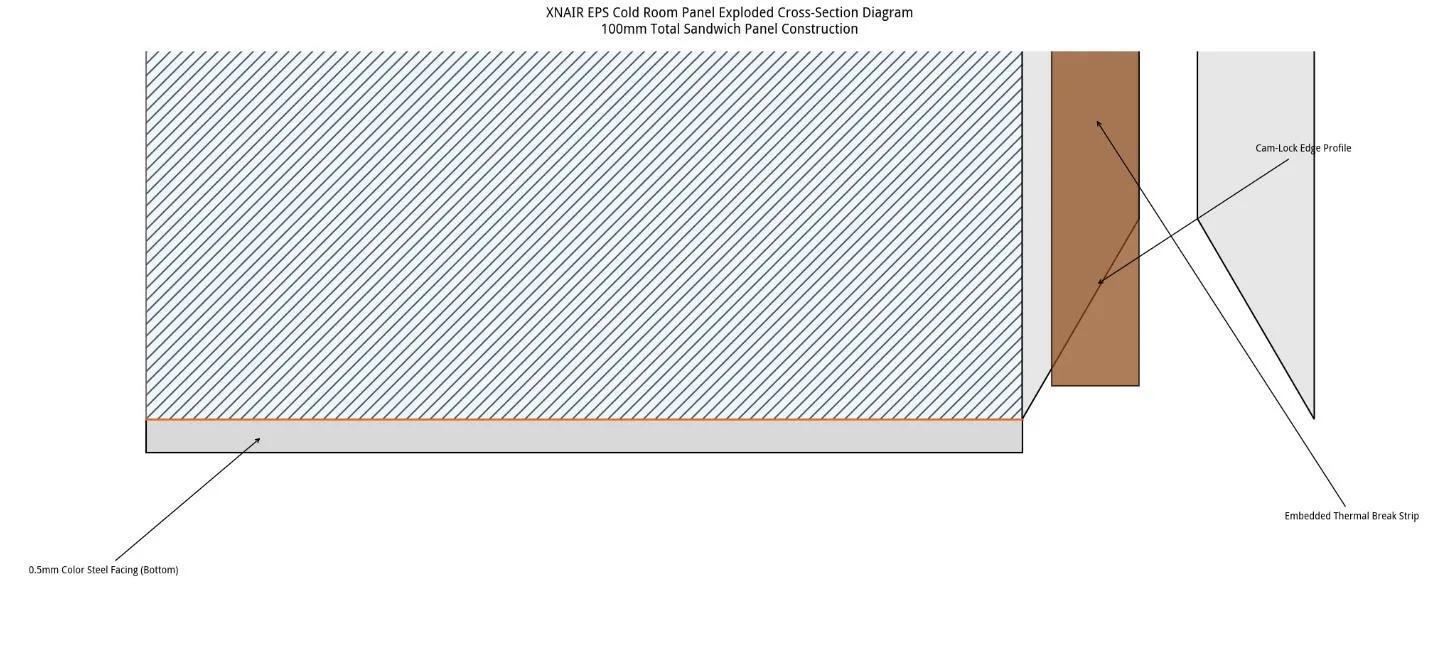
- Core Material: Expanded Polystyrene (EPS) foam manufactured via steam-expansion molding, achieving closed-cell structure with 95–98% air content by volume. Density is controlled between 12–40 kg/m³ depending on thermal and structural requirements.
- Facing Bonding: Two-component polyurethane adhesive is applied at 180–220 g/m² under controlled factory conditions (temperature 20±5°C, humidity ≤65% RH). The bond line is cured under uniform pressure to ensure full-surface adhesion without voids.
- Edge Profiling: CNC-machined tongue-and-groove or cam-lock profiles are cut after lamination, ensuring ±1mm tolerance on joint geometry. This precision is critical for achieving airtight panel-to-panel connections that prevent thermal bridging.
- Thermal Break Strip: A continuous PVC or EPDM gasket is embedded along the joint profile on both male and female edges. When panels are locked together, the dual gasket creates a triple-seal barrier against air infiltration and moisture migration.
- Corner & Junction Details: Factory-supplied pre-fabricated corner panels (90° internal/external) and T-junction profiles eliminate on-site cutting waste and ensure structural continuity at wall-to-wall and wall-to-ceiling transitions.
- Impact Resistance: The steel facing provides puncture resistance against incidental forklift impact in busy warehouse environments. For high-traffic zones, 0.6–0.8mm thick galvanized steel facings with ribbed profile are recommended as sacrificial bump guards at floor level.
Export Packaging & Logistics Reinforcement
International shipping of cold room panels—particularly to regions with challenging last-mile logistics—demands packaging that protects panel edges, facings, and joint profiles from transit damage. Our export packaging protocol has been refined through over 500 containerized shipments.
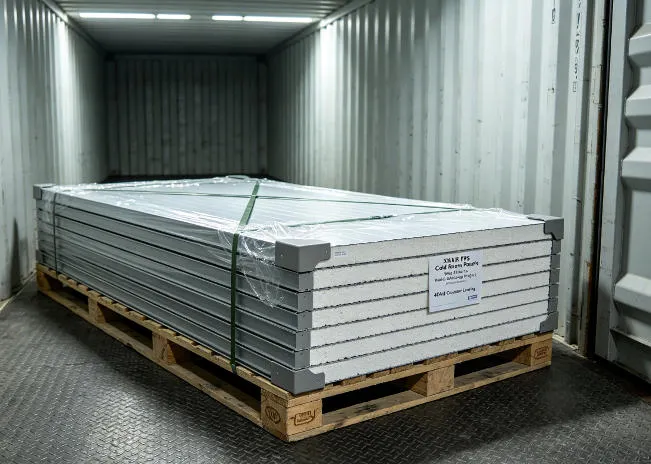
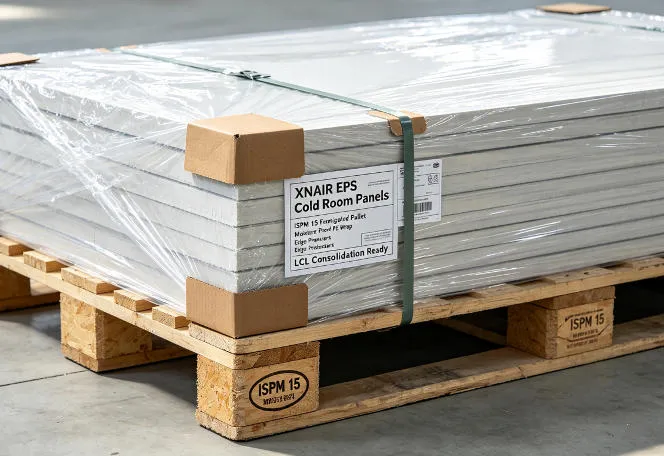
- Edge Protection: All four perimeter edges of each panel are fitted with heavy-duty cardboard or plastic edge protectors (3mm thick) before stacking, preventing denting and delamination at joint profiles.
- Moisture Barrier: Each palletized stack is wrapped in 150μm PE film with heat-sealed seams, creating a waterproof envelope that protects against condensation during sea freight and tropical port storage.
- Pallet Specification: ISPM 15 fumigated plywood pallets (1100×1100mm or 1200×1000mm) with a load capacity of 1,500 kg. Panels are stacked flat (never on edge) with 3mm interleaving protective sheets between each panel.
- Container Securing: Within the container, palletized stacks are positioned with dunnage air bags inflated to 0.2 bar between stacks, and heavy-duty polyester tension belts (breaking strength ≥2,500 kg) are applied in both longitudinal and transverse directions.
- LCL Shipments: For less-than-container-load orders, panels are packed in reinforced plywood crates with internal bracing, suitable for shared container transport without risk of shifting damage.
Quality Control & Factory Testing
Every batch of XNAIR EPS cold room panels undergoes a systematic quality assurance protocol before release for export. Our in-house testing laboratory is equipped for thermal conductivity measurement, dimensional verification, and mechanical property testing.
- Incoming Material Inspection: EPS raw beads are tested for bulk density, bead size distribution (0.5–2.5mm), and pentane blowing agent content before steam-expansion molding. Steel coil facings are verified for coating thickness (≥20μm for PE, ≥25μm for SMP) using digital coating thickness gauges.
- Dimensional Tolerance Check: Every panel is measured for length, width, thickness, and squareness (diagonal difference ≤2mm per 3m length) using calibrated laser measurement tools. Cam-lock profiles are checked with go/no-go gauges.
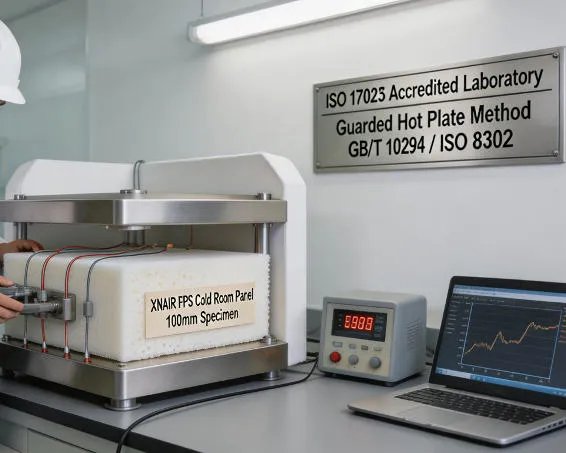
- Thermal Conductivity Batch Test: One sample per production batch (max 500 panels) is tested using a guarded hot plate apparatus per GB/T 10294 (equivalent to ISO 8302), with measurements taken at 10°C and 25°C mean temperatures.
- Bond Strength Test: A 90° peel test is performed on facing-to-core adhesion samples per GB/T 2790, with a minimum acceptance criterion of 0.15 N/mm for indoor applications and 0.20 N/mm for outdoor-exposed cold rooms.
- Full-Load Pre-Shipment Audit: Before container loading, 100% of panels in the shipment are visually inspected for surface defects, edge damage, and joint profile integrity. Random panels (min 5% of total) are selected for re-measurement of critical dimensions.
Frequently Asked Questions
The R-value depends on panel thickness and EPS density. For a 100mm panel with 18–22 kg/m³ EPS density, the R-value ranges from 2.85 to 4.55 m²·K/W. Thicker panels up to 200mm provide proportionally higher thermal resistance, suitable for deep-freeze applications down to -50°C. For precise R-value calculations tailored to your operating temperature, please contact our engineering team with your project specifications.
Yes. All XNAIR EPS cold room panels are manufactured to order. Standard widths are 960mm and 1150mm, with lengths customizable from 2m up to 12m. We also provide CNC-cut openings for doors, windows, and pipe penetration points according to your cold room layout drawings. Simply share your floor plan and elevation drawings, and our pre-sales engineering team will generate a panel cutting schedule for your approval before production begins.
The typical minimum order quantity for export is one 20-foot container (approximately 600–800 square meters of panel coverage, depending on thickness). For trial orders and project samples, we accommodate LCL (less-than-container-load) shipments. Contact our sales team with your project specifications for a precise quotation including freight options.
All XNAIR EPS cold room panels are packed with reinforced edge protectors, moisture-proof PE film wrapping, and are secured on fumigated plywood pallets (ISPM 15 compliant). Inside containers, panels are stacked flat with interleaving protective sheets and strapped with tension belts (breaking strength ≥2,500 kg). Our export packaging has been validated through 500+ international shipments across Africa, Southeast Asia, and the Middle East with a transit damage rate below 0.3%.
Quality Commitment & Industrial Certifications
XNAIR Refrigeration—operated by Shanghai XiangNing Electromechanical Equipment Co., LTD—maintains a rigorous quality management system that governs every stage of EPS cold room panel production, from raw material sourcing to final pre-shipment inspection.
ISO 9001:2015
Quality management system certified for the design, manufacture, and export of cold room panels and refrigeration equipment. Annual surveillance audits ensure continuous compliance.
CE Marking
EPS panels are CE marked under the Construction Products Regulation (EU) No 305/2011, with Declarations of Performance (DoP) available for EN 14509 compliance verification.
Fire Performance
Panels tested to GB 8624 (B1/B2 classification) and EN 13501-1. Test reports available upon request for building permit and insurance documentation in your jurisdiction.
Third-Party Lab Verification
Thermal conductivity, compressive strength, and dimensional stability are periodically verified by accredited independent laboratories including SGS and TÜV Rheinland.
Factory Testing Commitment: Before any EPS panel shipment leaves our facility, we conduct a 100% visual and dimensional inspection. A batch-level thermal performance test report is included with each shipment's documentation package. Panels that do not meet the specified thickness tolerance (±1mm) or exhibit facing delamination are rejected at source and recycled. We do not ship panels that fail any quality gate.
Related Cold Room Products
Explore complementary products in the XNAIR cold storage system portfolio. Each product is designed to integrate seamlessly with our EPS panel systems.