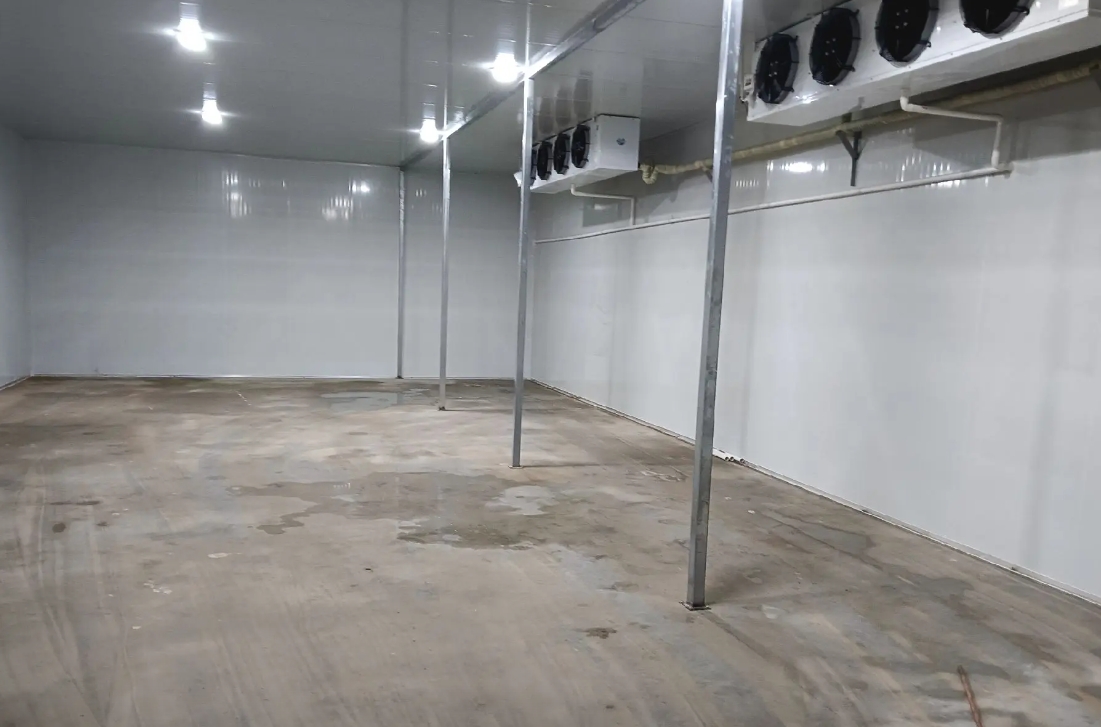
Shanghai XNAIR delivers -10℃ explosion-proof chemical cold storage in Jiaxing, using Emerson compressors and dual-layer insulation, meeting industrial material storage standards for Zhejiang Xinyu
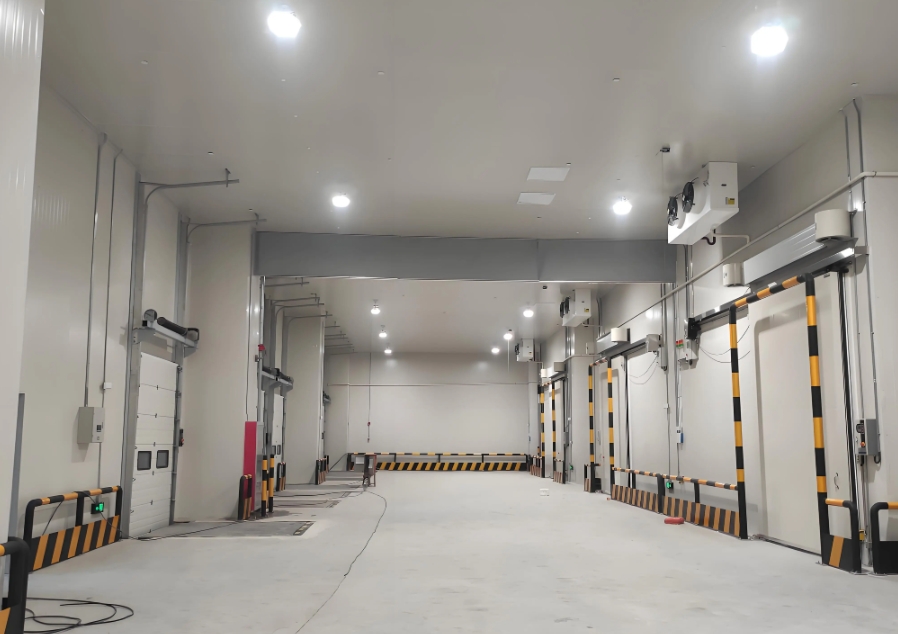
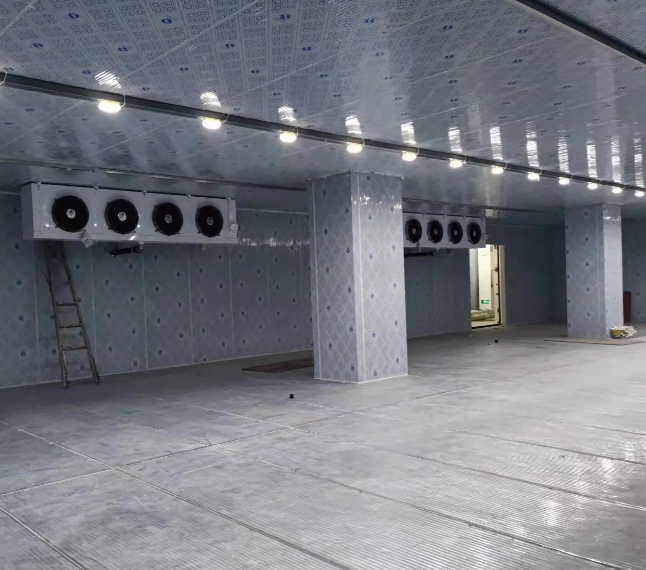
Zhejiang Xinyu Trading Co., Ltd. built a new explosion-proof cold storage with an effective volume of 104 cubic meters and a design temperature of -10°C at its chemical storage base in Xiuzhou District, Jiaxing, for storing low-flash-point organic solvents and polymerization reaction intermediates. The project was undertaken by Shanghai XNAIR Refrigeration Engineering Co., Ltd. (XNAIR). Equipment selection and construction of the entire cold storage comply with standards for Zone 2 hazardous explosive areas with Class IIB, Temperature Group T4 gas atmospheres. The enclosure adopts 150 mm polyurethane sandwich panels; the floor is constructed with 150 mm extruded polystyrene boards topped by a 100 mm reinforced concrete layer. The main refrigeration unit is an air-cooled explosion-proof condensing unit equipped with Emerson Copeland hermetic scroll compressors, and the control system adopts automatic PLC + touch screen control. This facility is intended to replace the previously rented off-site conventional cold storage. It shifts the storage of Category A flammable materials from ambient temperature to constant -10°C storage, meeting the storage temperature and explosion-proof environment requirements stipulated in the Regulations on the Safety Administration of Hazardous Chemicals and Material Safety Data Sheets (MSDS).
Project Background
Zhejiang Xinyu Trading Co., Ltd. specializes in the storage, transportation and distribution of chemical raw materials such as acrylic resins, polyurethane curing agents and diluents for coatings, with its products widely supplied to local automotive refinish and industrial coating manufacturers across Zhejiang. For some polymer-grade isocyanates and peroxide initiators stored at its chemical logistics center, their Material Safety Data Sheets (MSDS) explicitly specify a maximum storage temperature of -5°C, with strict separation from heat and ignition sources.
Previously, the company adopted a makeshift solution of retrofitting an ordinary third-party cold storage with split explosion-proof air conditioners. The warehouse lacked an integrated explosion-proof zoning design and suffered poor temperature uniformity. Temperature probe records showed the highest indoor temperature could reach -3°C in summer while edge areas dropped to only -8°C. Additionally, non-explosion-proof lighting fixtures and sockets inside the warehouse created severe non-compliance safety hazards.
Following an on-site inspection in October 2023, the Jiashan Emergency Management Bureau issued a rectification order mandating the construction of a standalone explosion-proof cold storage, which must be interlocked with the base’s flammable gas alarm system. In response, Xinyu resolved to build a small dedicated explosion-proof cold storage within its own logistics base for constant -10°C storage of Category A hazardous materials. Beyond meeting regulatory requirements, the facility was required to connect to the existing Warehouse Management System (WMS) to enable unattended automatic temperature control during goods warehousing.
Key Challenges
Challenge 1: Matching refrigeration equipment with gas explosion-proof classification
Vapors volatilized from stored materials mainly consist of butyl acetate, xylene and trace isocyanates. Per hazardous area classification standards, this environment falls under Zone 2, Gas Group IIB, Ignition Temperature Group T4. All electrical components of the refrigeration system—compressors, condenser fan motors, evaporator fan motors, defrost heating tubes and all auxiliary electrical accessories—must hold complete explosion-proof certification with a marking no lower than Ex d IIB T4 or Ex p IIB T4.
Off-the-shelf small air-cooled scroll units that simultaneously meet IIB T4 explosion-proof rating and -10°C evaporation temperature requirements are scarce on the market. Most manufacturers require a customization lead time of over 45 days, while the client only had a 60-day rectification deadline.
Challenge 2: Temperature field control within confined space
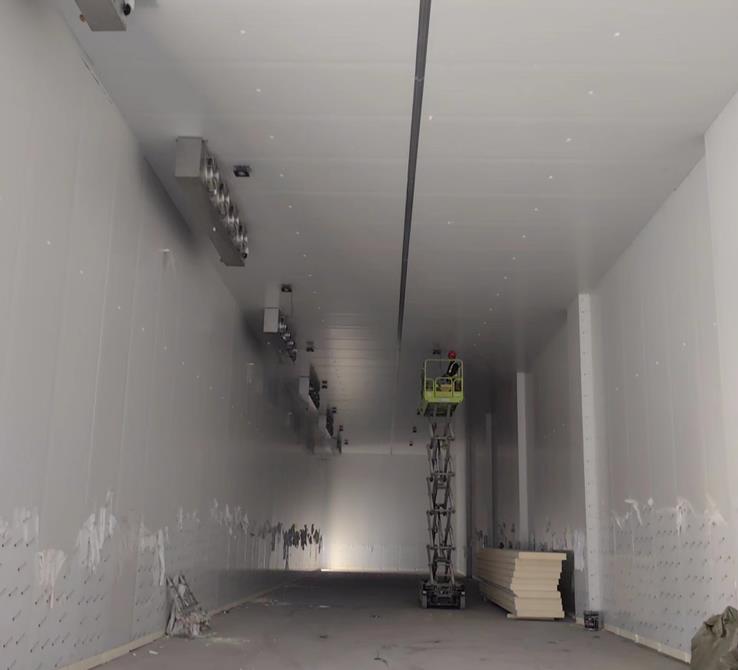
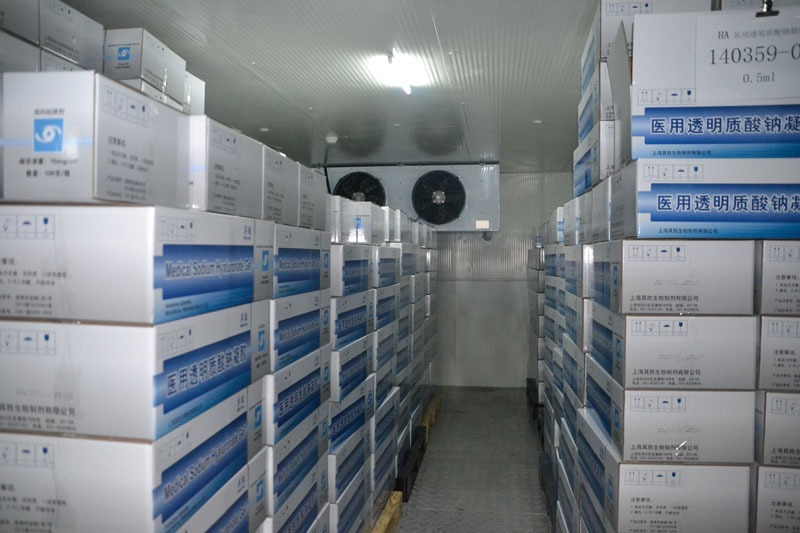
The cold storage has internal dimensions of 7.4 m (length) × 4.8 m (width) × 2.9 m (height), with an effective volume of merely 104 m³. Three layers of pallet racking are installed inside for high cargo turnover, requiring full warehouse door openings for loading and unloading at least twice daily. Dense storage in a compact space easily blocks cold air return passages, potentially creating a front-to-rear temperature difference exceeding 4°C inside the warehouse. Per material storage requirements, temperatures at all storage positions must stay within -10°C ±2°C; any deviation triggers audible and visual alarms and interlocks to cut off refrigerant supply to the refrigeration system.
Challenge 3: Dual requirements for floor thermal insulation and load bearing
Reach stackers are used for pallet loading and unloading inside the warehouse, with a combined weight of the forklift and loaded cargo exceeding 2.5 tons. Polyurethane wall panels cannot withstand long-term wheel loads. The floor slab must achieve a thermal resistance of R ≥5.0 m²·K/W while satisfying concentrated point load requirements.
Conventional cold storage floors adopt XPS insulation boards topped with reinforced concrete, yet the site’s original plain concrete floor only permits an overall elevation increase of 200 mm. Precise thickness allocation between the 150 mm XPS layer and 100 mm reinforced concrete layer was required. Structural measures were also implemented to resist shear slippage at the interface between XPS and reinforced concrete, preventing uneven compression of XPS under heavy loads that would crack the floor slab.
Challenge 4: Ventilation and flammable gas detection interlock logic
Flammable gas may accumulate inside the explosion-proof cold storage in the event of refrigerant leakage or damaged material packaging. Per design codes, fixed flammable gas detectors must be installed with two-stage alarm logic: the first alarm activates explosion-proof exhaust fans for forced ventilation, while the second alarm cuts off power to all non-intrinsically safe circuits inside the warehouse.
However, catalytic bead sensors suffer degraded response accuracy and shortened service life under -10°C low-temperature conditions. Infrared or cryogenic-resistant detectors were therefore selected. Special design measures also eliminated false triggering of sensors by water droplets generated during evaporator defrost cycles.
Design Scheme
The cold storage is designed for a target temperature of -10°C, an ambient design temperature of 35°C and relative humidity of 80%. The daily inbound cargo volume shall not exceed 30% of total stock, and the core temperature of incoming materials is controlled at no higher than 25°C. After item-by-item refrigeration load calculation, a 20% design margin is reserved.
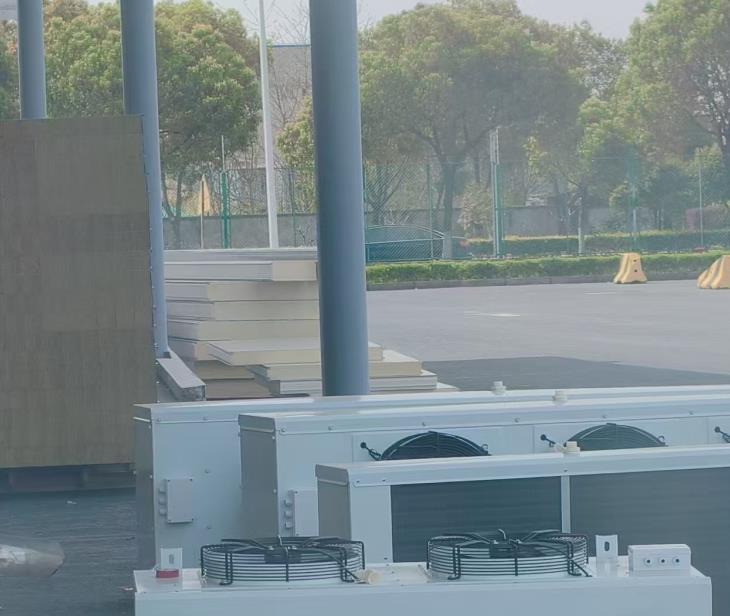
A single direct-expansion refrigeration system is adopted without secondary refrigerant, to narrow heat transfer temperature difference and cut the quantity of electrical equipment. To simplify pipelines and reduce leakage points in the explosive hazardous area, the condensing unit is installed in an external explosion-proof cabinet on the roof, while ceiling-mounted explosion-proof air coolers are deployed indoors. Liquid supply and suction pipelines penetrate the roof with explosion-proof sealed cable glands at wall penetration points. No electric heating defrosting is configured for the whole system; instead, natural temperature rise during shutdown and residual heat of drain pans are used for drainage, eliminating failure risks of explosion-proof electric heaters.
The exhaust system is equipped with one wall-mounted explosion-proof axial fan interlocked with two infrared flammable gas detectors inside the warehouse. The exhaust fan activates when any detector reads 25% LEL; upon reaching 50% LEL, the main power supply of the cold storage is cut off and alarm signals are uploaded to the fire control room.
Equipment List
| Equipment Name | Brand & Model | Function |
|---|---|---|
| Air-cooled Explosion-proof Condensing Unit | Emerson Copeland ZB29KQE-TFD fitted with explosion-proof cabinet (equipped with Ex d IIB T4 explosion-proof motor) | Compression and condensation, delivers cooling capacity under -10°C evaporation temperature condition |
| Ceiling-mounted Explosion-proof Air Cooler | Zhejiang Kaidi DD-5.6/ExdIIBT4 | Indoor heat exchange and air supply; 4.5 mm fin spacing to prevent rapid frost accumulation |
| Explosion-proof Cold Storage LED Light | Shenhai Explosion-proof LED-30W Ex d IIC T6 | Indoor lighting; IIC rating provides higher safety margin |
| Flammable Gas Detector | Hanwei BS03 II infrared type | Detects flammable gas concentration, outputs two-stage alarm signals |
| Explosion-proof Axial Exhaust Fan | Dezhou Yatong BT35-11-No2.8 ExdIIBT4 | Emergency ventilation with air change rate ≥12 times per hour |
| PLC Programmable Logic Controller | Siemens S7-200 SMART SR30 | Refrigeration regulation, alarm interlock, defrost timing |
| Touch Screen | Kunlun Tongtai TPC1061Ti | Parameter display, setting, historical curve query |
| Explosion-proof Distribution Box & Accessories | Qidong Explosion-proof Electric BXM(D) series | Power supply and distribution for cold storage, with intrinsic safety barrier interfaces built-in |
Construction Process
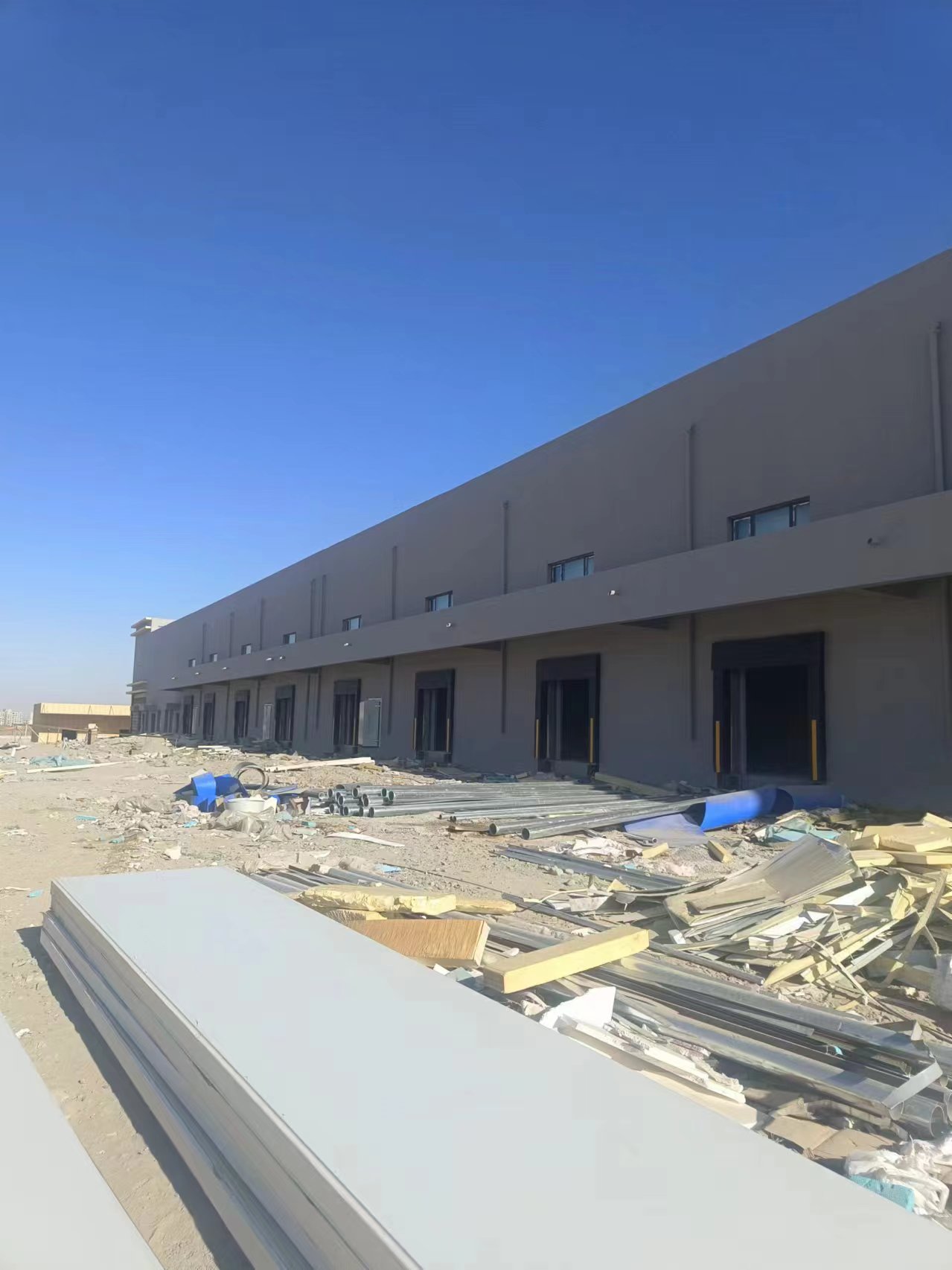
Prior to panel installation, the original floor is chiseled, coated with cold primer oil as moisture and vapor barrier, then laid with two staggered layers of 150 mm XPS extruded polystyrene boards. A 0.2 mm PE vapor barrier film is spread over the XPS layer with upturned edges wrapping the sides of insulation boards. A single-layer bidirectional steel mesh of Φ10@150 is bound, followed by pouring 100 mm C30 fine aggregate concrete finished with emery wear-resistant surface. Expansion joints are arranged to avoid high-frequency forklift wheel load zones.
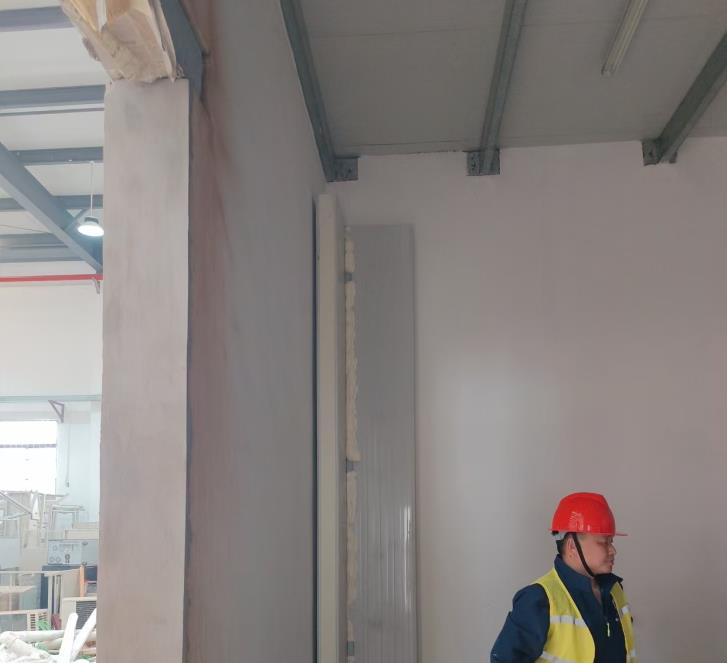
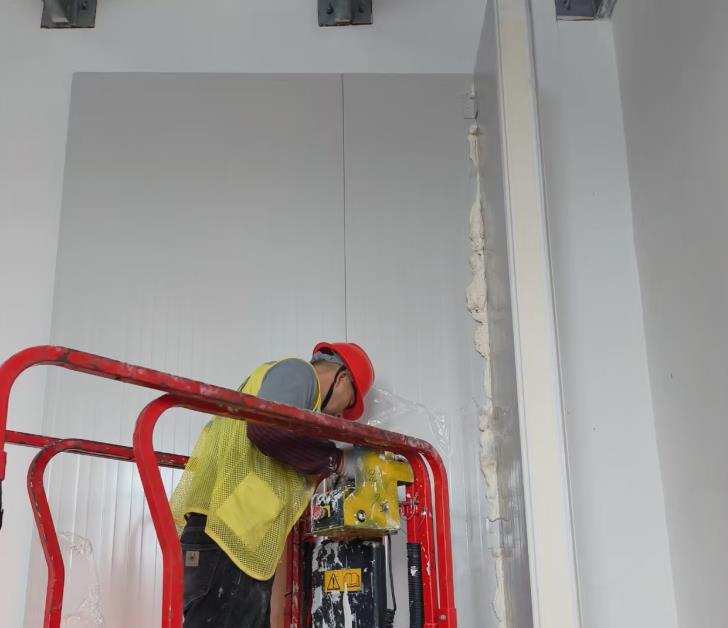
The warehouse enclosure uses 150 mm thick double-sided 0.6 mm stainless steel polyurethane sandwich panels. Panel joints are tensioned with special cam lock hooks, filled with mildew-resistant neutral sealant, then covered with aluminum foil tape on the indoor side to form double airtight barriers. Rubber vibration pads are fitted at connections between explosion-proof air cooler hangers and roof panels. Stainless steel drain pipes with electric heat tracing run from air coolers to outdoor explosion-proof floor drains.
The explosion-proof condensing unit is mounted on load-bearing steel frames on the roof. Refrigeration pipelines undergo pickling, purging and a 24-hour pressure holding test in compliance with oxygen-clean pipeline standards. R404A refrigerant is charged with accuracy of 0.1 kg. All cable conduits are galvanized steel pipes with explosion-proof sealed fittings; cold storage lighting circuits are isolated and sealed within junction boxes. The PLC control cabinet is placed in the duty room outside the hazardous area, connected to indoor detectors via intrinsic safety isolators, with a three-level security management password preset in control logic.
Commissioning & Acceptance
No-load cooling test
At ambient temperature of 32°C, the warehouse cools down from 25°C to -10°C within 52 minutes, and air coolers switch to intermittent operation automatically. The maximum temperature difference among 3 indoor measuring points is 1.1°C.
Full-load simulation test
Empty drums filled with antifreeze of the same chemical type are used as thermal load with a total weight of 2.8 tons and initial inbound temperature of 20°C. It takes 2 hours and 15 minutes for the warehouse to recover to -10°C. During long-term stable operation, temperature rise during defrosting does not exceed 2.5°C, and the temperature bounces back to -10°C within 20 minutes after defrost completion.
Flammable gas detector function test
Standard concentration isobutane gas bags are placed close to sensors. The exhaust fan automatically starts at the first alarm threshold of 25% LEL, and the cold storage main power supply is reliably cut off at the secondary threshold of 50% LEL.
A third-party institution qualified for explosion-proof electrical inspection conducts acceptance of explosion-proof electrical installation, inspecting all sealing points, grounding resistance and circuit intrinsic safety parameters before issuing an inspection report. The client’s safety & environment department carries out overall fire interlock acceptance together with the base fire control room; the system realizes signal communication with the base fire alarm controller, and all functions pass inspection at one time.
Validation Results
After 72 consecutive hours of unattended data logging, the warehouse temperature was maintained between -10.5°C and -9.2°C under no-load conditions. Under daily full-load inbound and outbound handling conditions, temperatures at all recording points ranged from -11.2°C to -8.6°C, complying with the target index of -10°C ±2°C.
Defrost water drained smoothly without ice buildup on interior surfaces or air coolers. The zero drift of flammable gas detectors at low temperatures was less than 1% LEL. All sealing joints of explosion-proof electrical equipment remained tight, with a grounding resistance of 0.3 Ω.
Actual Operational Performance
After the cold storage was connected to the client’s WMS system, forklift operators set picking tasks via the explosion-proof touch screen outside the warehouse. Door opening duration is limited to 90 seconds, with temperature rebound not exceeding 1.5°C.
The built-in data logging module of the PLC automatically generates daily and monthly reports, which can be uploaded to the corporate server via Ethernet for remote review by the Health, Safety & Environment (HSE) department.
During hot and humid summer periods, the condensing pressure of the condensing unit stays stable at approximately 15.5 bar with discharge temperature not exceeding 85°C. The Emerson compressors maintain favorable energy efficiency without overload or high-pressure alarms.
Indoor lighting operates reliably under frequent switching, and no false alarms are triggered by the infrared gas detectors.
Project Benefits
The newly built explosion-proof cold storage completely eliminates compliance risks arising from the previously rented ordinary cold storage for Zhejiang Xinyu Trading, enabling smooth passage of re-inspection by the Emergency Management Bureau.
Meanwhile, annual inventory loss of high-value materials such as isocyanates and initiators has been reduced from the original 1.8% to below 0.3%, primarily because stable temperature control slows down side polymerization reactions.
In terms of warehouse management, this facility exclusively stores three types of filed-recorded materials to realize dedicated warehouse for dedicated goods. Batch QR codes are linked with temperature records, providing downstream clients with a more reliable quality data chain and improving traceability during supplier audits.
No matter your industry, no matter how complex your refrigeration needs, XNAIR Cold Storage can provide you with customized, energy-efficient solutions. Contact us now to start your successful project!
Contact XNAIR Cold Storage Now →Hedong Canteen Cold Storage Project at East China Normal University: Customized catering cold storage solution with German Bitzer system, -18℃ and 2-8℃ dual-temperature zones, energy-efficient design...
View Details →Shanghai XNAIR builds climate-resilient seed cold storage for Wuwangnong Seed in Lishui, maintaining 0-10℃ stability at 43℃ ambient with 48hr backup power, ensuring genetic resource security....
View Details →XiangNing Cold Storage provided EPC solutions for Hetian Eheng's agricultural cold chain logistics center in Pishan County, including thermal insulation materials, installation, and intelligent contro...
View Details →Shanghai XNAIR delivers 5-10℃ adjustable cold storage for Xihekang's semiconductor silicone raw materials in Xuhui, using Embraco compressors and modular design to ensure material stability for el...
View Details →Shanghai Haohai Biotech's 2024 pharmaceutical cold storage project, featuring German Bitzer refrigeration & Schneider control systems, meets GMP/ISO standards for high-precision medical storage....
View Details →Shanghai XNAIR delivers fire-resistant 0-5℃ tobacco leaf cold storage for Jiangxi Tobacco Research, using German GEA refrigeration and B1-grade insulation to meet agricultural research & food safe...
View Details →Phone
+86 180 1742 6215Tel
Shanghai XiangNing Electromechanical Equipment Co., LTD XML